
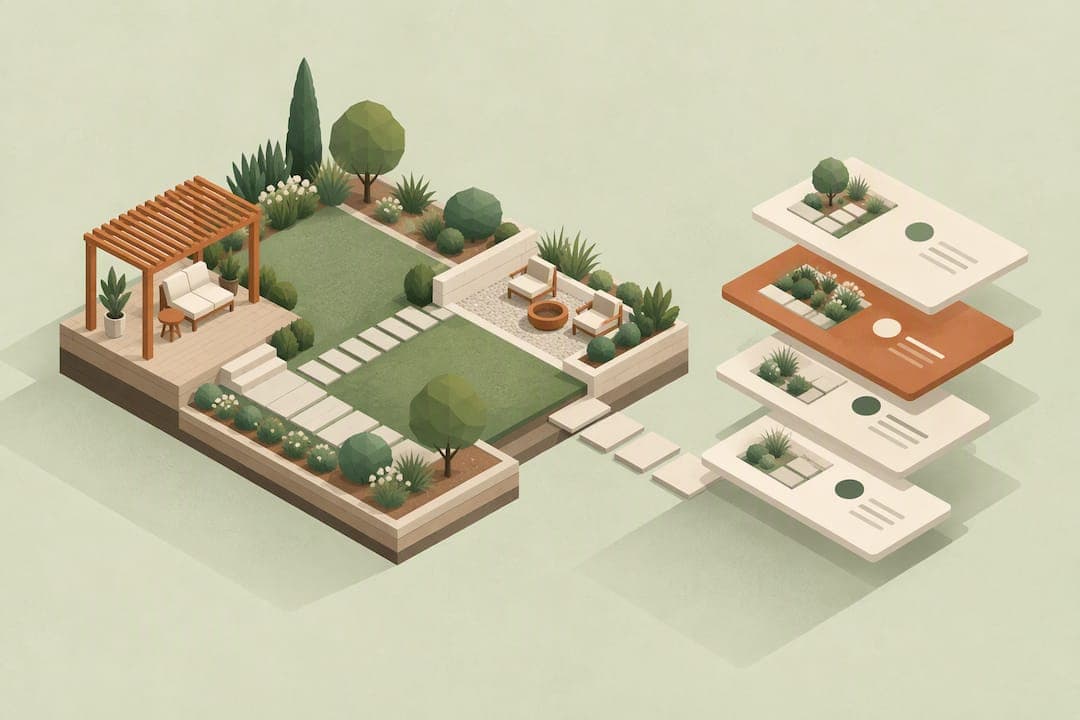
Most residential projects fall into one of three cost ranges: a standard refresh typically runs in the lower thousands, an upgraded remodel costs a moderate amount more, and a luxury backyard overhaul starts at a higher budget and increases from there. The spread comes down to site conditions, material choices, and how much hardscape and irrigation the design includes. The sections below walk through how to calculate your own number, break down each component, and plan for the water and maintenance costs that follow installation.
TL;DR:
- A standard landscaping project typically costs between $3,000 and $12,000 for yards up to 2,000 square feet, with costs rising based on scope and complexity.
- Hardscape features, irrigation, and mature plants significantly increase prices, especially if including custom masonry, outdoor kitchens, or smart systems.
- Material choices and labor rates, including site prep challenges and access issues, are primary factors driving cost differences between bids.
- Accurate budgeting benefits from detailed, itemized estimates and using tools that tie pricing directly to design components, reducing surprises.
- Long-term costs, including maintenance and water usage, should be factored into the budget, as they can be as impactful as initial installation expenses.
Table of Contents
- What counts as a landscaping project and how pros size a budget
- Price bands and three sample budgets you can adapt
- What actually moves your quote up or down
- Per-feature costs: patios, walls, turf, planting, irrigation, lighting
- How to turn a quote into your own budget
- Budgeting for the next 10 to 25 years, not just installation
- Where to cut costs and find rebates
- How a 3D planning tool keeps your estimate accurate
- What homeowners get wrong about landscaping budgets
- Try building your own live estimate
- FAQ
- Sources
What counts as a landscaping project and how pros size a budget
Contractors generally sort jobs into three scopes, and knowing which one matches your plan helps you read quotes correctly. A standard refresh usually means new plant beds, mulch, basic sod or seed, and maybe a small walkway. An upgraded remodel adds hardscape like a patio or retaining wall, a zoned irrigation system, and more mature plantings. A luxury build folds in custom masonry, outdoor kitchens, specimen trees, and automated irrigation and lighting systems tied together in one design.
Quotes are built around a few standard units, and learning them makes it much easier to compare bids; for more practical advice, see the Sacred Garden Designs blog.
- Square footage for turf, planting beds, patios, and mulch coverage.
- Linear footage for walls, edging, fencing, and drip irrigation lines.
- Per-plant or per-tree pricing, which varies heavily by size and maturity.
- Hourly or per-crew-day labor rates, often bundled into a flat installation fee.
Your own numbers will shift based on region, slope, and existing soil quality, but these assumptions give you a consistent starting point to adjust from.
Price bands and three sample budgets you can adapt
Here is how the three bands typically break down, along with sample builds you can scale to your own yard size.
- Standard ($3,000 to $12,000): New sod or seed over 1,000 to 2,000 square feet, basic foundation planting, mulch beds, and a simple walkway. This tier skips major hardscape or irrigation upgrades.
- Upgraded ($12,000 to $45,000): A 300 to 500 square foot paver patio, a short retaining wall, zoned drip and spray irrigation, and a mix of shrubs and small trees. This band is where most mid-size backyard remodels land.
- Luxury ($50,000 and up): Custom hardscape across multiple zones, mature tree planting, smart irrigation controllers, landscape lighting, and often a built-in seating or kitchen feature. Costs here scale with square footage of hardscape more than anything else.
A practical way to use these bands is to build a sample takeoff for your own lot. Say a 1,500 square foot backyard gets 400 square feet of paver patio, 600 square feet of new sod, a 40-foot retaining wall, and a basic drip irrigation zone. At typical mid-range rates, that combination often lands in the $18,000 to $28,000 range before contingency, which puts it solidly in the upgraded tier. Professional, hardscape-heavy projects commonly run above $20 per square foot once labor and materials are fully priced, while simpler DIY-friendly projects can come in under $5 per square foot according to one municipal budgeting guide, which shows how much scope and material choice can swing the final number.
Use these three samples as templates: swap in your region's price per square foot, adjust the hardscape percentage up or down, and recalculate. That single adjustment usually gets you within a reasonable range of what a local contractor will quote.

What actually moves your quote up or down
A handful of factors explain most of the gap between a $5,000 estimate and a $25,000 one.
- Material selection drives both unit cost and installation time. Natural stone costs more than poured concrete and takes longer to set, while basic mulch beds install in a fraction of the time a paver patio requires.
- Fully loaded labor rates matter more than the hourly wage a crew member earns. Industry guidance on contractor labor costs notes that payroll taxes, insurance, and workers' comp add real burden on top of base wages, so a quote built only on hourly pay will understate the true job cost.
- Site prep surprises like rock removal, poor drainage, or grading add cost that rarely shows up in an initial walkthrough estimate.
- Irrigation complexity scales with the number of zones, whether you choose drip over spray, and whether you add a smart controller.
- Access and disposal costs rise when equipment can't reach the work area directly or when old materials need hauling away.
An itemized estimate that separates materials, labor, equipment, overhead, and permits is the clearest way to compare two bids fairly, according to the same labor cost analysis. If a quote bundles everything into one number, ask for a line-item breakdown before signing.
Per-feature costs: patios, walls, turf, planting, irrigation, lighting
Breaking a budget into components makes it much easier to spot where you can save or splurge.
- Patios and walkways: Concrete pavers tend to sit at the lower end, natural stone and custom masonry at the higher end, and costs climb further once a gravel subbase or extra grading is needed on uneven ground.
- Retaining walls: Price scales with wall height and material, and any wall over a couple of feet typically needs a drainage system behind it to avoid frost heave or water pressure damage.
- Turf: Sod gives you an instant lawn but costs more upfront, seed is cheaper but takes weeks to establish, and synthetic turf carries the highest installation cost but removes ongoing watering and mowing. Over a 25-year horizon, Value Landscape Engineering research from Utah State University found that warm-season turf can cost less overall than cool-season turf in many high-desert regions, since lower water and maintenance needs offset a slightly higher installation price.
- Planting: Small shrubs and perennials cost little per unit, while mature trees and specimen plants command a premium because of their size and the labor needed to transport and install them.
- Irrigation: A basic drip or spray system covers the basics, while a smart controller with weather or soil-moisture sensing adds cost upfront but can cut water waste substantially over time, per EPA WaterSense guidance.
- Lighting and add-ons: Low-voltage path and accent lighting is a relatively low-cost way to extend usability into the evening, while features like fire pits or outdoor kitchens add significantly more.
How to turn a quote into your own budget
Calculating your own ballpark number is straightforward once you know the formula contractors use internally.
- Multiply area by price per square foot. Take your square footage for turf, patio, or planting beds and multiply by your region's typical rate for that material.
- Add a contingency of 10% to 25% on top of the subtotal to cover site surprises like rock, drainage issues, or price changes on materials.
- Convert hourly crew rates into total job cost by multiplying the fully loaded hourly rate by estimated man-hours, not just the number of workers on site.
- Build a takeoff checklist before calling contractors: note square footage by zone, linear footage for walls and edging, plant counts by size, and an estimated hour range for labor.
- Request an itemized estimate from every bidder that separates materials, labor, equipment, permits, and overhead, along with a payment schedule and any warranty terms in writing.
Budgeting for the next 10 to 25 years, not just installation
Installation is only part of the real cost. The Value Landscape Engineering approach, developed through research at Utah State University, treats a landscape as a lifecycle investment: installation cost, annual operations and maintenance, and eventual replacement all belong in the same budget.
- Annual maintenance typically includes mowing, pruning, fertilization, and irrigation checks, and these costs recur every year the landscape exists.
- Water usage varies enormously by turf and plant choice, and a maintenance manual for sustainable landscaping recommends regular irrigation inspection and correct mowing heights to keep water use and replacement needs down over time.
- Replacement timelines differ by material: turf may need renovation after a decade, while hardscape and trees often outlast the original owner.
- Comparing options over a multi-year horizon, rather than just upfront price, is how the Utah State model shows warm-season turf outperforming cool-season turf in many climates despite a higher sticker price at installation.
Where to cut costs and find rebates
A few tactics consistently lower both the upfront bill and what you pay afterward.
- Phase the project by tackling planting and mulch yourself while hiring pros for hardscape and irrigation.
- Target water-saving upgrades, since smart controllers and turf replacement often qualify for local rebates, and some programs pay per square foot for removing turf, as noted in Utah's homeowner landscape resources.
- Buy mulch, compost, and plants locally and in bulk, and check community plant swaps or landfill compost programs for lower-cost material.
- Spend more upfront on durable items, like a quality irrigation controller or a well-built retaining wall, when the lifecycle savings outweigh the initial cost difference.
Pro Tip: Check your local water utility's rebate page before finalizing an irrigation plan. Many offer cash back for smart controllers or turf replacement that can offset a meaningful chunk of installation cost.
How a 3D planning tool keeps your estimate accurate
Pricing errors usually come from one of two places: a quantity that was never measured correctly, or a material swap that didn't get recalculated through the whole plan. A 3D planning tool like Veete ties pricing directly to each object in your design, so changing a patio material or adding a planting bed updates quantities and totals automatically instead of leaving you to redo math by hand.
- Swap materials and see the lifecycle cost shift instantly, which makes it easier to compare a cheaper paver against a pricier stone before committing.
- Export a shopping list or contractor scope straight from the plan, so bids are based on the same quantities instead of each contractor measuring independently.
- Reduce disputes by handing over a clear geometric layout with itemized pricing attached, rather than a rough sketch and a verbal estimate.
What homeowners get wrong about landscaping budgets
The most common mistake is budgeting for materials and labor while ignoring site prep and water costs, which quietly eat up a tenth or more of most project budgets. The second is treating installation as a one-time expense instead of the first year of a 10 to 25 year commitment.
If you're prioritizing, spend first on irrigation design and soil prep since both are expensive to redo later, and phase in lighting, decorative hardscape, or specimen plants once the bones of the yard are solid.
— Rokas
Try building your own live estimate
A 3D plan with pricing attached to every object turns these ranges into a real number for your yard in minutes, not hours of manual measuring.
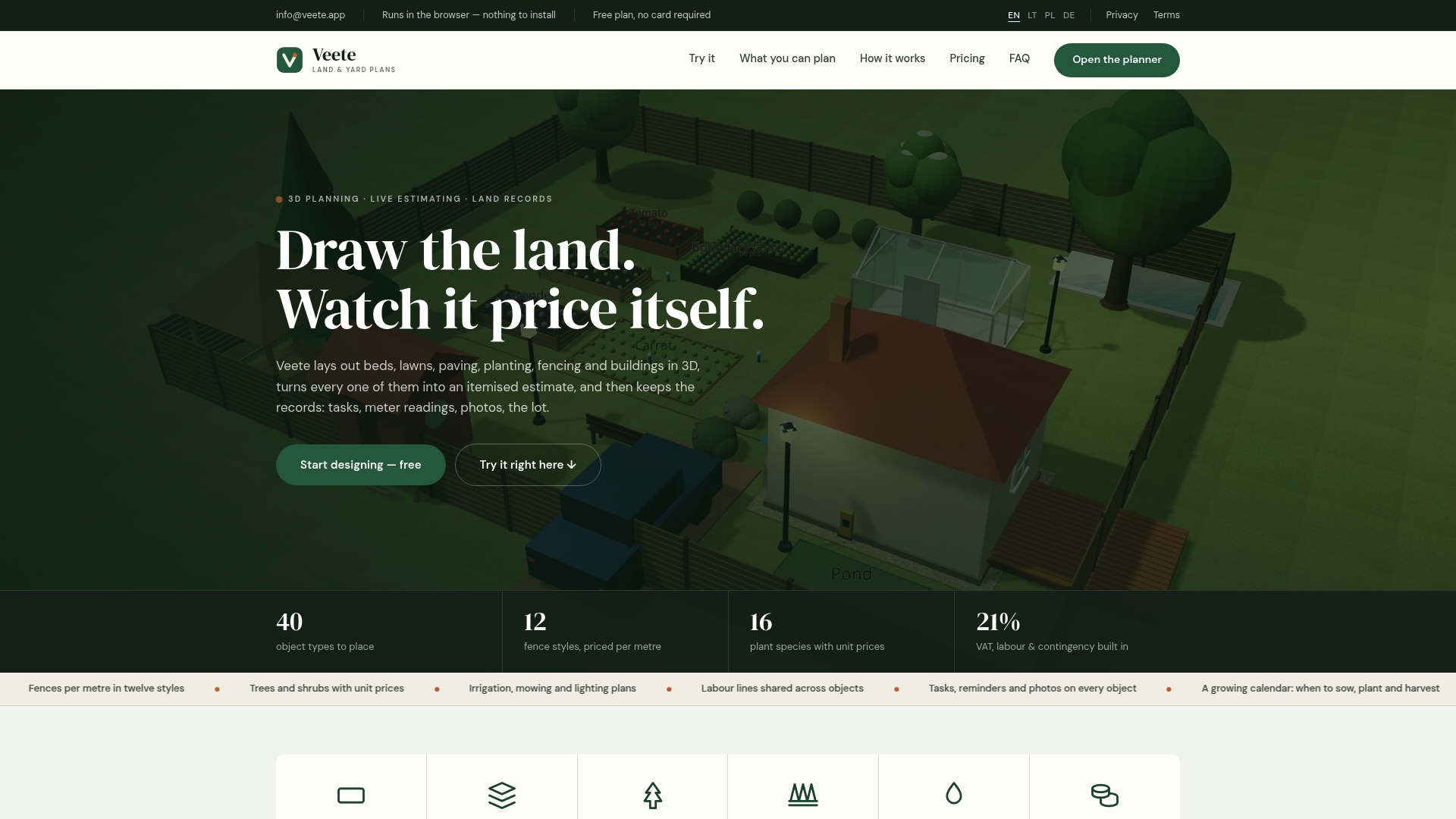
Start a project on the Free plan with no card required, or move to Home or Pro when you need multiple projects and export features.
FAQ
What is a realistic budget for landscaping my home?
Most homeowners land between $3,000 and $12,000 for a standard refresh, $12,000 to $45,000 for an upgraded remodel with patio or irrigation work, and $50,000 or more for a luxury build. Your actual number depends on yard size, hardscape percentage, and local material and labor rates.
Is $100 an hour too much for landscape work?
A posted hourly wage rarely reflects the true crew rate, since fully loaded labor costs include payroll taxes, insurance, and equipment burden on top of base pay, according to industry labor cost data. Whether a rate is fair depends on your region and the complexity of the work, so compare it against itemized bids rather than judging the number alone.
How do I calculate landscaping costs?
For labor, multiply the fully loaded hourly crew rate by estimated man-hours rather than relying on a flat day rate.
Is $200 a month for lawn care good?
Whether lawn service costs are reasonable depends on lawn size, service frequency, and what's included, such as mowing, fertilization, and irrigation checks. Comparing a few itemized local quotes is the most reliable way to judge if the price fits your yard and service level.
Sources
- Value Landscape Engineering: identifying costs, water use, labor, and impacts to support landscape choice (Utah State University)
- EPA WaterSense — WaterSense labeled controllers
- Utah Homeowner Landscape Resources (Conserve Water Utah)
- Smartscape maintenance manual for sustainable landscaping (Pima/Arizona adaptation)
- The real cost of labor for lawn & landscaping businesses in 2026 (Service Autopilot)