
Landscaping labor in 2026 typically bills between $25 and $45 an hour for basic maintenance, $45 to $85 for skilled trades like irrigation and hardscape, and $75 to $125 in high-cost metros for licensed contractors. These are billed rates, not paychecks: they cover overhead, insurance, and profit margin, not just the worker's wage. Below, we break down how to turn these ranges into a real project estimate.
TL;DR:
- Skilled trades like irrigation and hardscape typically bill between $45 and $85 per hour, especially for certified contractors with licensing in high-cost metro areas.
- The total project estimate depends heavily on equipment, permits, crew speed, and overhead, which can significantly increase the actual hourly rates paid.
- Estimating labor costs involves breaking the project into tasks, assigning benchmark rates, multiplying by hours, and adding contingency, with design tools offering real-time updates.
- Regional and seasonal factors cause substantial rate differences, with high-cost areas and peak seasons pushing prices upward and off-seasons offering softer rates.
- Contractor billing methods vary: hourly rates suit unpredictable work, flat bids work for fixed projects, and cost-plus offers transparency for large design-build jobs.
Table of Contents
- 1. Benchmark hourly rates by service and skill level
- 2. Primary cost drivers that change hourly rates
- 3. How to estimate labor cost for your project
- 4. Regional and seasonal variation you should expect
- 5. Hourly billing, flat bids, and cost-plus pricing compared
- 6. Why billed rates run higher than worker wages
- 7. Turning these rates into a real estimate with a 3D plan
- 8. When to hire a pro and when to DIY
- Build your own itemized estimate with Veete
- Sources
- FAQ
1. Benchmark hourly rates by service and skill level
Rates scale with skill, licensing, and the tools required for the job. A crew mowing lawns costs less per hour than a licensed irrigation technician diagnosing a broken valve, and that gap widens further for specialized arborist work.
For basic maintenance, mowing, edging, and blowing typically run $25 to $45 per worker per hour. A two-person install crew is usually billed as a unit rather than as two individual rates, since shared travel time and equipment costs get folded into one crew price. Skilled trades sit higher: irrigation repair, hardscape installation, and arborist work land in the $45 to $85 range, reflecting certification requirements and the cost of specialized tools. Licensed contractors working in expensive metro markets can bill $75 to $125 an hour, particularly for design-build work that requires a general contractor's license.
- Basic maintenance: $25 to $45 per hour per worker, often billed as a flat visit fee instead.
- Two-person install crews: billed as a unit, not doubled from an individual rate.
- Skilled trades: $45 to $85 per hour for irrigation, hardscape, and arborist services.
- Licensed contractors in high-cost metros: $75 to $125 per hour for design-build and permitted work.
A quick conversion example: a four-hour hardscape job at $65 an hour costs $260 in labor before materials, equipment, or a contractor's markup are added.
2. Primary cost drivers that change hourly rates
Quotes vary widely because several factors stack on top of the base labor rate. Understanding them helps you spot where you can control cost and where you cannot.
Skill level and licensing matter most. A crew member with an arborist certification or a state contractor's license commands a higher rate because the credential itself carries liability and training costs. Equipment needs are another driver: a job requiring a skid steer, a stump grinder, or a trencher adds rental or ownership costs that get passed through, and insurance and permit fees for larger jobs add a layer most homeowners never see itemized. Crew production rates also shift the math: a fast, experienced crew that clears a job in three hours instead of five effectively lowers your total cost even at the same hourly rate, since production-rate measurement is how reputable estimators avoid under-bidding in the first place. Business overhead and seasonal demand round out the list: a company with a shop, trucks, and year-round staff bills more per hour than a solo operator, and rates climb during peak spring and fall demand.
- Skill and licensing: certifications and contractor licenses raise the base rate.
- Equipment and permits: specialized machinery, insurance, and permit fees add hidden costs.
- Crew production rate: a faster crew can lower your total bill even at a higher hourly rate.
- Overhead and season: established companies and peak months both push rates upward.
Pro Tip: Ask contractors whether their quote is priced by the hour or by the job. A per-job price rewards a fast, efficient crew, while an hourly price only rewards you if the job runs short.
3. How to estimate labor cost for your project
Estimating labor cost is a repeatable process once you break a project into its component tasks. This method mirrors what professional estimators do, just at a homeowner scale.
- List every task in the project (bed prep, planting, edging, mulch, drip line install) and estimate hours for each using typical crew output as a guide.
- Assign a benchmark hourly rate to each task category from the ranges above, using the skilled-trade rate for specialized work and the maintenance rate for simple tasks.
- Multiply hours by rate for each task and add them together to get your labor subtotal.
- Add equipment fees, haul-off charges, and materials handling, then build in a contingency of roughly 10 to 15% for surprises like buried rock or drainage issues.
- Compare your total to contractor bids line by line, checking that their labor hours and rates roughly match your estimate before you accept a number that looks too low or too high.
A 200 square foot planting bed with a 30 foot drip line illustrates the math: bed prep and planting at two hours at $35 an hour comes to $70, drip line installation at one hour at $55 an hour adds $55, and mulch spreading at 30 minutes at $30 an hour adds $15. That is a $140 labor subtotal before materials or a contingency buffer.
Getting your production-rate assumptions right matters: measuring how much a crew installs per hour for sod, planting, or hardscape is the difference between a realistic estimate and a guess that leaves you underfunded mid-project.

4. Regional and seasonal variation you should expect
National benchmarks are a starting point, not a local price. Your actual quote depends heavily on where you live and when you schedule the work.
Coastal metros and the Northeast typically sit at the high end of the national range, with market analyses showing 40 to 60% differences between low-cost and high-cost regions. West Coast metros follow a similar pattern, driven by higher wages, insurance costs, and permit fees. Timing matters just as much as location: spring and early fall are peak demand periods when crews are booked solid and prices firm up, while late fall and winter often bring softer pricing as companies look to keep crews busy. To calibrate benchmarks to your area, check regional BLS wage tables for your metro, browse local job listings such as those for the Lake Norman area to see what crews are actually being paid, and ask two or three local companies for ballpark hourly rates before you request full bids.
- High-cost regions: Northeast and West Coast metros run above national averages.
- Peak season: spring and fall bring firmer pricing and longer wait times.
- Off-season: late fall and winter often bring softer prices and faster scheduling.
- Local calibration: regional wage tables and local job boards reveal what your market actually pays.
5. Hourly billing, flat bids, and cost-plus pricing compared
The billing model a contractor uses affects both your risk and your ability to compare quotes fairly.
Hourly billing works well for maintenance, repairs, and jobs with an unpredictable scope, since you pay only for time worked. It usually includes labor and basic tools but often excludes specialty equipment rentals. A flat bid suits well-defined installation projects like a patio or a planting bed, where the contractor measures the site, estimates hours and materials, and commits to a single price regardless of how long the job actually takes. Cost-plus pricing, common on larger design-build projects, charges you for actual labor and material costs plus a fixed percentage markup, which can be more transparent than a flat bid because you see the underlying costs rather than a bundled number.
- Hourly billing: best for maintenance and unpredictable-scope repairs.
- Flat bid: best for clearly defined installation jobs with a fixed scope.
- Cost-plus: best for large design-build projects where transparency matters more than a fixed number.
Watch for minimum service fees, separate equipment charges, and travel time billed as a line item. Any of these can turn a reasonable hourly rate into a surprising invoice total.
6. Why billed rates run higher than worker wages
The gap between what you pay per hour and what the worker on your lawn actually earns is called labor burden, and it explains most of the confusion homeowners feel when comparing a quote to a wage they read online.
Labor burden includes payroll taxes, workers' compensation insurance, liability insurance, equipment costs, and administrative overhead. Contractors commonly apply a multiplier of 2.5 to 3.5 times payroll cost to arrive at a billable rate, which is why a worker earning close to the median wage still generates a much higher line item on your invoice. The median hourly wage for grounds maintenance workers was $18.50 in May 2024, a useful baseline for what a worker takes home before that multiplier is applied. Government wage data reflects pay, not the price you're quoted.

7. Turning these rates into a real estimate with a 3D plan
A 3D planning tool lets you measure your beds, turf, and hardscape directly and assign a task type to each object, so the labor rate attaches to the actual square footage rather than a guess. Some 3D planning tools work this way: you draw your layout, tag each area as planting, turf, or hardscape, and attach a benchmark hourly rate with an estimated hours-per-object figure.
- Measure beds, lawn, and paving directly in the plan and assign a task category to each.
- Attach an hourly rate and hours estimate to each object to build a labor line item.
- Watch pricing update live when you resize a bed or add a path, so the estimate never falls out of sync with the design.
8. When to hire a pro and when to DIY
Hire a crew for anything involving grading, drainage, electrical work near irrigation systems, or heavy hardscape, where a mistake costs more than the labor saved. Mulching, planting small beds, and routine mowing are usually safe and cheaper to handle yourself if you have the time. Whichever route you take, get two or three bids and confirm each one covers the same scope before comparing numbers.
— Rokas
Build your own itemized estimate with Veete
Getting a defensible number to compare against contractor bids usually means measuring your space accurately and pricing each element yourself, which is exactly what Veete is built for. Draw your beds, lawn, and hardscape in 3D, attach the benchmark rates from this guide to each object, and get an itemized, exportable estimate instead of a rough guess on a napkin.
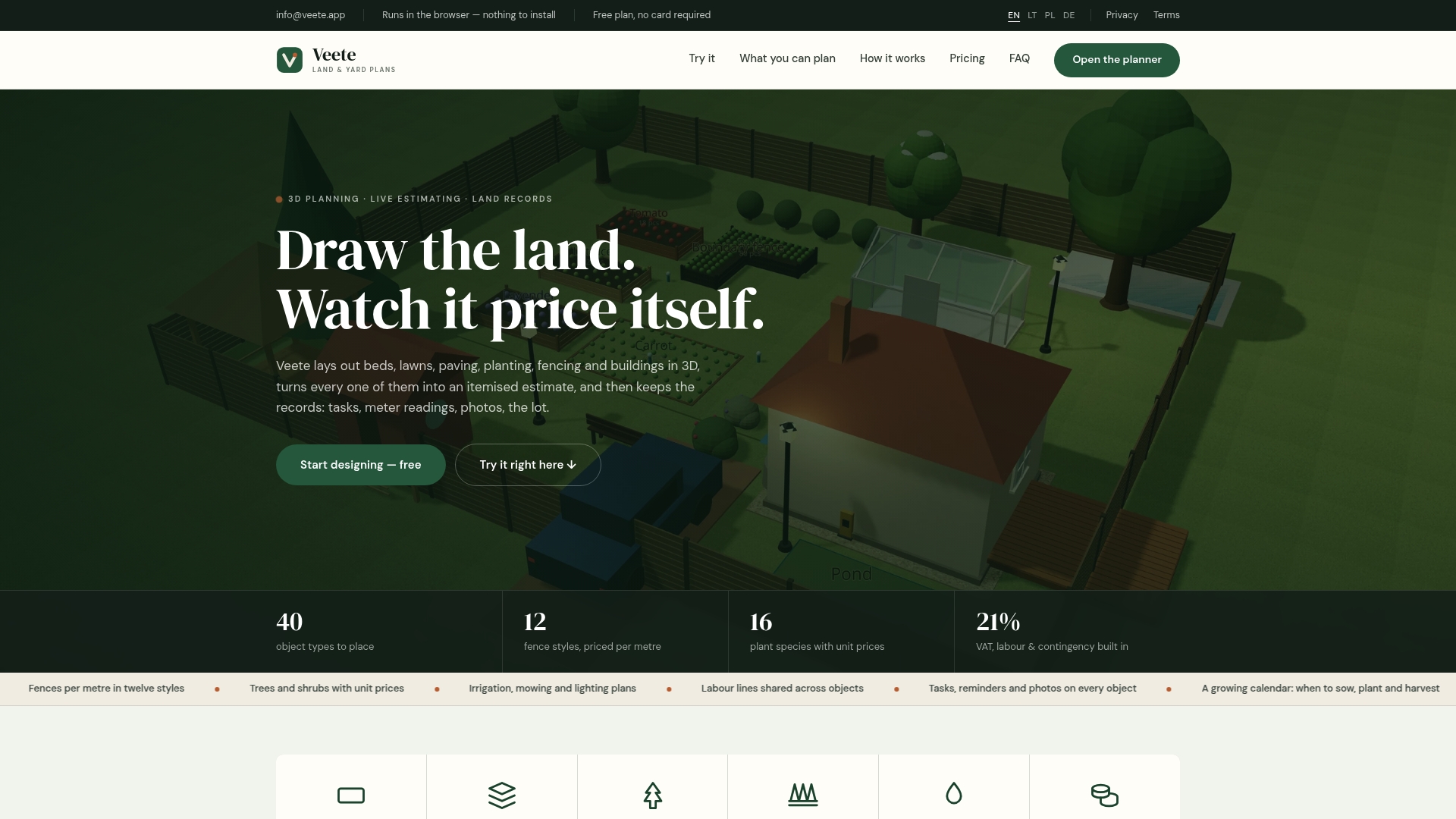
- Design your layout in 3D and see live pricing update as you adjust beds, turf, or paving.
- Avoid the common estimating mistake of quantities falling out of sync after a design change.
- Start on the free tier with no card required, or compare the Home and Pro plans on the pricing page when you need multi-project features.
Sources
For raw wage figures, check the Bureau of Labor Statistics occupational wage tables, which break out pay by specialty. Industry reports from NALP track wage trends and hiring pressure. Local job boards and regional pricing guides fill in the gaps national averages miss.
- Grounds Maintenance Workers : Occupational Outlook Handbook: : U.S. Bureau of Labor Statistics
- Landscaping Labor Costs 2026: Hourly Rates, Markup Structures, and What Actually Drives Your Total Bill — YardCost
- Landscaping Costs USA: 2026 Overview | Techo-Bloc
FAQ
Is $100 an hour too much for landscape work?
Not necessarily. An hourly rate within the licensed contractor range for high-cost metros is typical, especially for permitted or design-build work. For basic mowing or maintenance, that same rate would be well above the typical benchmark and worth questioning.
What is the average labor rate for landscaping?
Rates vary by task and skill level rather than a single average. Basic maintenance typically bills $25 to $45 per hour, while skilled trades like irrigation and hardscape run $45 to $85, and licensed contractors in expensive metros can reach $125.
How much for 2 hours of yard work?
At the basic maintenance rate of $25 to $45 per hour, a couple of hours of yard work costs proportionally based on those hourly rates before any minimum service fee some companies apply. Many maintenance companies bill a flat per-visit rate instead of a strict hourly one.
Is $20 an hour good for landscaping?
For a worker's wage, an amount close to the median hourly wage of $18.50 for grounds maintenance workers reported in May 2024 is typical, making it a reasonable pay rate. As a billed rate charged to a homeowner, $20 an hour would be below typical market benchmarks, since billed rates include overhead on top of the worker's wage.