
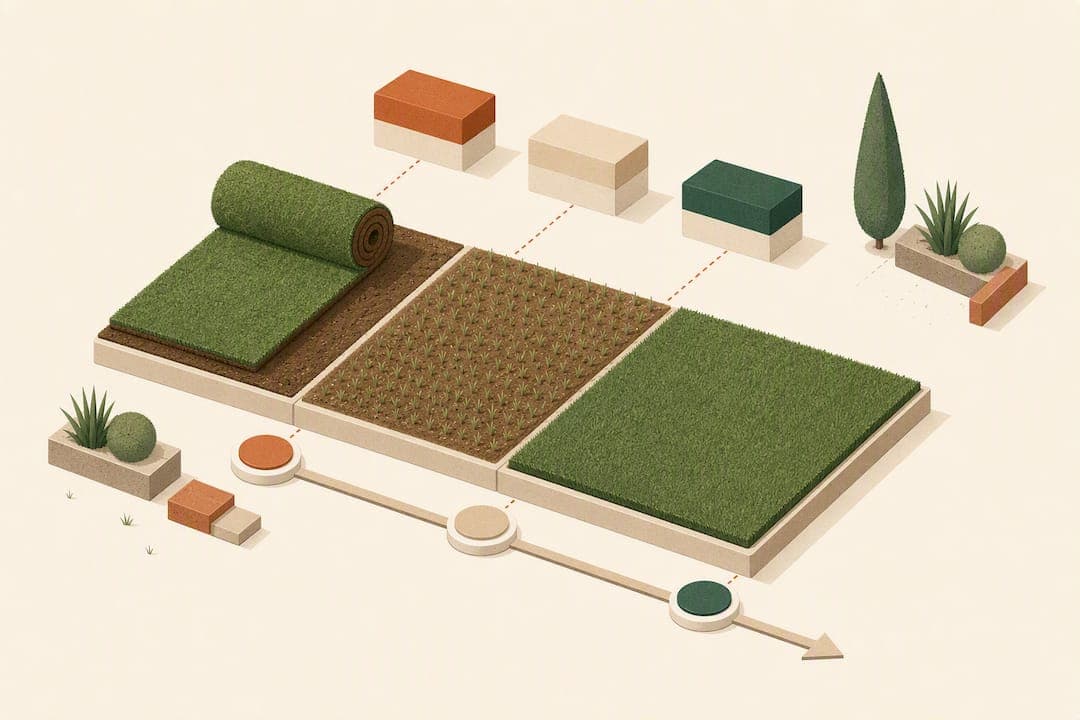
Expect to pay $1.00 to $3.00 per square foot for seeding or hydroseeding, $1.50 to $4.00 per square foot for sod, and $6 to $25 per square foot for artificial turf, according to cost data compiled by HomeGuide. Material choice matters, but site preparation and irrigation work usually swing the final bill more than whether you pick seed, sod, or turf. Get those two line items nailed down before you compare quotes.
TL;DR:
- Site preparation, including grading and irrigation, often adds $1 to $4 per square foot to the base cost, significantly impacting the total quote.
- Sod installation requires installation within 24 hours of cutting, and certain premium grass varieties are only available as sod or plugs, not seed.
- Artificial turf prices vary widely from $6 to $25 per square foot depending on system complexity, base materials, and infill; long-term replacement costs can also be substantial.
- Expect seed and hydroseed costs to be similar ($1 to $3 per square foot), but seed may incur higher ongoing water and fertilization expenses during the first season.
- Accurate budgeting benefits from detailed measurement, soil testing, and itemized quotes that include all site-prep and hidden costs before selecting a method.
Table of Contents
- Lawn Installation Cost by Method: Seed, Sod, and Turf Compared
- What Drives Your Lawn Installation Quote Beyond the Grass
- Total Project Costs by Lawn Size
- How Long Until Your New Lawn Is Actually Usable
- DIY vs. Hiring a Pro for Lawn Installation
- Building an Accurate Lawn Installation Estimate
- What I'd Tell a Friend Before They Sign a Lawn Contract
- Turn Your Lawn Budget Into an Actual Plan
- Sources
- FAQ
Lawn Installation Cost by Method: Seed, Sod, and Turf Compared
The per-square-foot price tag on any lawn quote hides a lot of variables. Two contractors quoting "sod installation" for the same yard can land $2 apart per square foot depending on grass species, soil condition, and how much grading the crew has to do before a single roll goes down. Here's what actually drives the number within each method.
Hand-seeding runs $1.00 to $3.00 per square foot, and it's the cheapest way to establish a lawn from scratch. That price usually covers seed, starter fertilizer, straw or mulch cover, and basic soil prep, but it rarely includes irrigation setup. The catch is that seed is a bet on weather and follow-through. Grass choice has to match your climate: warm-season grasses germinate best between 70°F and 95°F, while cool-season grasses do better planted in fall, according to Texas A&M's turfgrass establishment guidance. Miss that window and you're reseeding bare patches next season, which erases whatever you saved upfront.
Hydroseeding sits at the same $1.00 to $3.00 range, sometimes running slightly higher, because the seed, fertilizer, and mulch get sprayed on as a slurry that holds moisture better than dry seed and straw. It's a reasonable middle ground on slopes or larger properties where erosion is a concern but a full sod budget doesn't make sense.
Sod (also called turf installation or resodding) costs $1.50 to $4.00 per square foot, roughly double the seed price for a good reason: you're buying an established root mat instead of gambling on germination. Extension specialists at the University of Arkansas note that sod is faster and more reliable than seed for erosion control, because it gives you a usable lawn in weeks instead of months. That premium mostly pays for reduced risk and less watering fuss during establishment, not just the grass itself.
Artificial turf costs $6 to $25 per square foot, by far the widest range of the three, because the price depends heavily on the base system, infill type, and pile height you choose. A budget synthetic patch for a small side yard lands near the bottom of that range; a premium putting-green-style install with drainage engineering and antimicrobial infill sits at the top.
Here's what tends to surprise first-time buyers about each method:
- Sod needs to be installed within about 24 hours of being cut at the farm, or it starts drying out and losing quality before it ever reaches your yard, per University of Arkansas Extension.
- Some premium grass varieties, including improved Bermuda, buffalograss, zoysia, and St. Augustine, are sold only as sod or vegetative plugs, never as seed, which forces the method decision for you regardless of budget.
- Seed's low sticker price hides ongoing costs: expect more irrigation, fertilizer, and weed control through the first season, since a thin young stand of grass can't crowd out weeds the way an established sod mat can.
- Artificial turf's biggest hidden cost isn't installation. It's what happens 8 to 15 years down the line when the infill degrades and the whole system needs replacing.
Pro Tip: Ask any sod supplier for the harvest date before you buy. Sod cut more than a day or two before delivery loses moisture fast, and a stressed lawn right out of the gate usually means dead patches and a repair bill within weeks.
On the turf side, a government technical review flags concerns that go beyond price per square foot. New Jersey's Department of Environmental Protection points to heat buildup, drainage and runoff issues, and infill materials that may contain PFAS as ongoing considerations, not one-time installation costs. Artificial grass can genuinely cut water use and mowing time, but treating it as a "install once, forget forever" purchase misreads the real lifecycle math.
Sod's rooting timeline also affects what you can and can't do with your yard during the first month. Rooting typically takes 10 to 14 days under proper watering, and Purdue Extension recommends keeping foot traffic off it for a full 3 to 4 weeks. If you're installing sod before a backyard event, plan for that window, not against it.
What Drives Your Lawn Installation Quote Beyond the Grass
Site preparation is where lawn installation quotes go from "reasonable" to "why is this so much more than the per-square-foot number I read online." A contractor's per-square-foot price for sod or seed almost never includes what has to happen to the ground first.
1. Old lawn removal and grading. If you're replacing an existing lawn, someone has to kill or strip the old grass, then regrade the surface so water flows away from your house instead of pooling in low spots. This step alone can add $0.50 to $1.50 per square foot depending on how uneven the yard is and whether the old lawn needs herbicide treatment or physical sod-cutter removal.

2. Soil testing and amendments. Good contractors test soil pH and composition before adding anything, since dumping topsoil or compost on the wrong base can waste money and still leave you with a lawn that struggles. Purdue Extension's installation sequence puts soil testing and amendment before grading and planting for exactly this reason. Skipping this step is one of the most common ways homeowners end up paying twice for the same lawn.
3. Irrigation and drainage. These are the two items most likely to get left off a "lawn installation" estimate entirely, then show up as a change order once work starts. Sprinkler systems typically add $1,500 to $4,000 for an average residential lot, and drainage work (French drains, dry wells, regrading for slope) can run anywhere from a few hundred dollars for minor fixes to several thousand for a yard with real water problems. Contractors generally install drainage and irrigation lines after rough grading but before the final grade goes down, since doing it out of order risks tearing up the finished surface later.
4. Access, slope, and staging. A flat, easily accessible backyard costs less to work on than a steep hillside lot or a property where equipment has to be hauled through a narrow side gate by hand. Steep slopes also often require erosion control matting or hydroseeding instead of standard sod, which changes the material cost too.
Three questions worth asking every contractor before you sign anything:
- Does this quote include grading and old lawn removal, or is that priced separately?
- Is irrigation or drainage work included, and if not, what's the estimated add-on cost?
- What's your policy if hidden issues (rocky soil, poor drainage, tree roots) show up mid-project?
Pro Tip: Get the "what's excluded" list in writing before comparing bids. A $4,500 quote that excludes grading and a $6,000 quote that includes it aren't actually $1,500 apart, they're roughly the same price with different paperwork.
Total Project Costs by Lawn Size
Per-square-foot ranges are useful, but most homeowners want a real number for their actual yard. Here's how the math plays out at common lawn sizes, using national ranges reported by HomeGuide's cost data alongside the method-specific ranges above.
These totals cover materials and standard installation labor. Site prep, irrigation, and drainage from the section above sit on top of these numbers, not inside them.
If you're ordering sod yourself or want to sanity-check a quote, sod is typically sold by the square yard and shipped by the pallet, with roughly 50 square yards (450 square feet) per pallet. A few practical notes:
- Always order about 10% extra to cover cutting waste around curves, beds, and edges.
- A 1,000 square foot lawn needs roughly 111 square yards of sod, or about 2.5 pallets once you factor in the overage.
- Regional pricing swings widely: sod and labor in the Southeast and parts of the Midwest often run cheaper than the Northeast or West Coast, so treat the ranges above as a starting point and plug in local supplier quotes for your real number.
How Long Until Your New Lawn Is Actually Usable
Cost and timeline are tied together more than most people expect, because every extra week of careful watering and restricted access is an operational cost even if no money changes hands.
Sod roots in about 10 to 14 days with consistent watering, but Purdue Extension recommends staying off it for 3 to 4 weeks total before normal foot traffic resumes. That means if you're installing sod for a spring gathering, you need to start the project a full month out, not a week out.

Seeded and hydroseeded lawns take considerably longer. Germination alone can run two to four weeks depending on species and weather, and the lawn typically isn't ready for regular foot traffic for six to eight weeks after that. During germination, the surface needs to stay consistently moist, which often means light watering multiple times a day rather than one deep soak, according to Oregon State University Extension.
A few things that change your risk and your timeline:
- Planting seed outside the ideal temperature window for your grass species dramatically raises the odds of patchy germination and rework.
- Sod planted in extreme heat needs closer watering attention than sod planted in mild spring or fall conditions.
- Rainy stretches can actually help seed and hydroseed but can delay sod delivery and installation if the ground gets too soft to work.
- Skipping a daily moisture check during the first two weeks is a common reason seeded lawns fail in patches.
DIY vs. Hiring a Pro for Lawn Installation
Some lawn work genuinely rewards a weekend of DIY effort. Other parts of the job punish it.
- Overseeding thin patches or small bare spots is a solid DIY project. A bag of seed, a rake, and some starter fertilizer will run you under $100 for most residential trouble spots.
- Small sod patches (repairing a dead corner, patching after a utility dig) are manageable DIY work if you can rent or borrow a sod cutter, which typically costs $60 to $100 a day.
- Full-yard grading, irrigation installation, and drainage work are where professional help earns its cost. Getting the slope wrong on a full regrade can send water toward your foundation instead of away from it, and that mistake is far more expensive to fix than the labor would have cost to do right the first time.
- Large sod installs (anything over a few thousand square feet) benefit from professional crews simply because sod dries out fast once cut. A crew of three can lay a pallet in under an hour; one homeowner working alone on a hot day risks losing sod quality before it's even in the ground.
- When comparing contractor bids, ask specifically what warranty covers, whether it includes a replacement guarantee if the lawn fails within a set window, and whether the price is locked or subject to change once they see the actual soil conditions.
Building an Accurate Lawn Installation Estimate
Most lawn budgets go wrong not because homeowners pick the "wrong" method, but because they price the grass and forget everything around it. A tighter process fixes that.
Start by measuring your actual square footage rather than guessing, then get a basic soil test. From there, list every site-prep item your yard will need: grading, old lawn removal, drainage, irrigation. Only after that should you lock in a method, since your climate and soil conditions often narrow the realistic choices anyway. Finally, collect two or three local supplier prices for sod, seed, or turf material before you build your total.
The part that trips people up is that a single change, like adding irrigation or switching from seed to sod, changes almost every other number in the estimate. That's the specific problem a tool like Veete is built around: because pricing is tied directly to each object in your design, adjusting one element (say, swapping a seeded area for sod, or adding a drainage line) automatically updates the whole itemized total instead of forcing you to redo the math by hand.
Pro Tip: Build your estimate with contractor-shareable output in mind from the start. A plan you can export and hand to three different bidders gets you more comparable quotes than three verbal walk-throughs where each contractor measured the yard slightly differently.
- Measure and sketch the space before calling anyone
- Test soil before committing to a grass species or amendment plan
- Price site prep and material separately, not as one bundled number
- Keep a running itemized total so a single design change doesn't blow up your whole budget silently
What I'd Tell a Friend Before They Sign a Lawn Contract
The mistake I see most often isn't picking the wrong grass. It's signing a quote without knowing what's excluded from it. Ask directly: does this number include grading, drainage, and irrigation, or will those show up as add-ons once the crew is already in your yard?
Second, budget for water access before installation day, not after. Temporary hoses, timers, or a rented sprinkler setup for the establishment period cost little, but forgetting them mid-project means a rushed, expensive scramble while your new lawn is drying out.
And prep really is where projects fail. A beautiful pallet of sod laid over poorly graded, untested soil is a repair bill waiting to happen, not a finished lawn.
— Rokas
Turn Your Lawn Budget Into an Actual Plan
Every number in this guide is a range because your yard isn't a national average. Some planning tools offer live, itemized pricing linked directly to every object in a 3D design, so when you adjust your lawn area, add a drainage line, or switch from seed to sod, the total cost updates automatically instead of leaving you to redo the math by hand. This helps keep your plan and budget in sync as your project changes.
You can start free, no card required, and build a real layout of your lawn, beds, and structures with pricing attached to each piece. If your project grows beyond a single yard, the Home and Pro plans add multi-project support and export tools you can hand straight to a contractor for bidding. Check the pricing page and sketch your first layout before you request a single quote.
Sources
- Establishing a Lawn From Sod (Purdue Extension)
- Turfgrass establishment guidance (Texas A&M)
- Establishing a Lawn From Sod (University of Arkansas Extension)
- Synthetic turf review (NJDEP, 2025)
FAQ
How much does it cost to sod 500 square feet?
Sodding 500 square feet typically costs $750 to $2,000, based on the standard $1.50 to $4.00 per square foot range for sod installation. Seeding the same area runs cheaper, around $500 to $1,500, but takes longer to establish.
How much does 2,000 square feet of turf cost?
Artificial turf costs vary greatly based on base system and infill quality. Sod and seed costs for any area vary based on materials and labor, according to cost data from HomeGuide.
How much does it cost to get a lawn installed?
Total lawn installation cost depends entirely on size and method: a typical 1,000 square foot yard runs $1,000 to $3,000 for seed, $1,500 to $4,000 for sod, or $6,000 to $25,000 for artificial turf. Site prep like grading, drainage, and irrigation usually adds to those totals separately.
How much would it cost to have a lawn laid with sod?
Laying sod costs $1.50 to $4.00 per square foot for materials and standard labor, which covers a 1,000 square foot yard at $1,500 to $4,000. That price typically doesn't include grading, old lawn removal, or irrigation, which are usually quoted as separate line items.
Is DIY sod installation actually cheaper than hiring a pro?
DIY sod installation saves on labor cost, but only pays off for small areas since sod dries out quickly once cut and needs to go down fast. For anything beyond a small patch, most homeowners find the labor savings get eaten up by wasted sod or a patchy result that needs redoing.
Can a planning tool help estimate lawn installation cost accurately?
Yes. A tool like Veete lets you build a 3D layout of your lawn and site-prep elements with pricing linked to each object, so the total updates automatically as you adjust the design. Veete offers a free plan to start, with paid Home and Pro tiers available on the pricing page for larger or multi-project needs.