
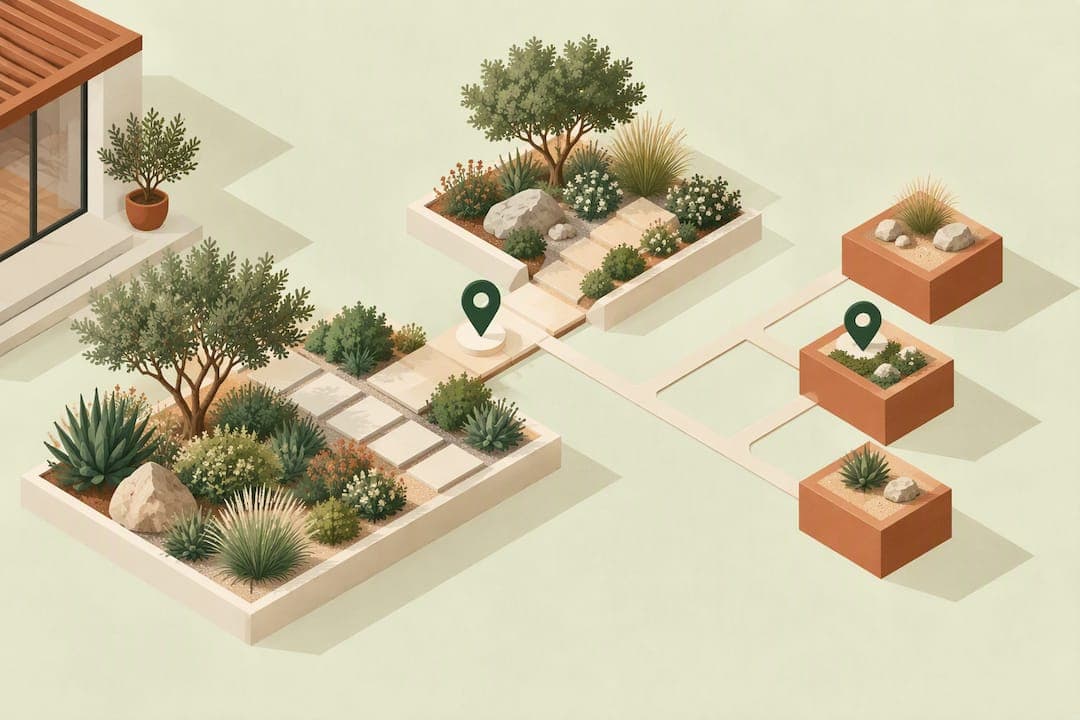
Low maintenance landscaping is achievable by cutting back unnecessary turf, grouping climate-adapted plants into hydrozones, and relying on mulch and smart irrigation to do the routine work for you. No yard runs itself completely, and the first two to three years will demand more attention while plants establish. After that, the payoff is a landscape that needs far less of your weekend.
TL;DR:
- Using durable hardscape, group plants into well-planned hydrozones, and mulch beds to minimize ongoing lawn trimming and weeding efforts.
- Start with a detailed site map that tracks sun exposure, drainage, and soil conditions to prevent planting mistakes that increase future maintenance.
- Select plants based on mature size, micro-site needs, and repeat a limited palette of hardy species to simplify care and suppress weeds.
- Implement efficient irrigation with drip zones, rain sensors, and mulch to reduce water use and prevent overwatering of drought-tolerant plants.
- Budget carefully by comparing partial turf reduction and long-lived plants against full redesign costs, using 3D planning tools to visualize and optimize layout before planting.
Table of Contents
- 1. Practical low-effort landscaping ideas that actually work
- 2. Mapping your site before you plant anything
- 3. Choosing plants that match your site and repeat well
- 4. Setting up water and irrigation the smart way
- 5. Picking hardscape, mulch and groundcover materials
- 6. What to expect during the first two to three years
- 7. Weighing installation costs against years of upkeep
- 8. How a 3D planning tool helps you avoid maintenance mistakes
- A few honest priorities for your own yard
- Plan your yard before you commit a single dollar
- Extension and university resources worth bookmarking
- Sources
- FAQ
1. Practical low-effort landscaping ideas that actually work
Some changes cut your workload more than others. According to extension research, paving and patios require the least ongoing care, followed by structures, trees and shrubs, then ground covers and lawns, while bulbs, annuals and many perennials demand the most attention of all, according to Clemson's low-maintenance landscape guidance. That ranking is a useful filter when you decide what to change first.
- Shrink your lawn in stages. Convert a section of turf at the edges or in awkward corners to beds or groundcover rather than ripping out the whole yard at once.
- Swap high-maintenance turf for a lower-input variety or alternative groundcover where foot traffic is light, such as clover or a drought-tolerant sedge mix.
- Add hardscape where mowing is a hassle, including narrow strips beside fences, steep slopes, or tight corners that a mower cannot reach cleanly.
- Group plants into hydrozones so high-water and low-water species are never on the same irrigation line, and pair that with drip irrigation and a rain-sensing timer.
- Mulch every bed to suppress weeds and hold soil moisture, and choose groundcovers that spread to fill gaps instead of bare soil.
- Build your plant palette around repetition, leaning on evergreen shrubs, ornamental grasses, and succulents or perennials repeated in masses rather than one-off specimens.
Continuous beds with simple shapes, flush edging, and planting strips wide enough to walk and kneel in cut down on hand trimming and string-trimmer time, a point extension guidance makes directly in its low-maintenance landscape ideas. A path that eliminates an awkward mowing strip pays for itself in time saved every single week.
Pro Tip: Start with the area you see most from your kitchen window or front door. Visible beds motivate upkeep; forgotten corners just grow weeds.

2. Mapping your site before you plant anything
A low-maintenance layout starts on paper, not at the nursery. Walking your yard and noting conditions before you buy a single plant prevents the single biggest source of future labor: plants in the wrong spot.
- Track sun and shade across the day in each season, since a bed that is full sun in June can be shaded by October.
- Note drainage patterns, including where water pools after rain and where it drains too fast for thirsty plants.
- Test or at least observe your soil, checking texture and compaction in different zones of the yard.
- Keep healthy existing trees and shrubs rather than clearing everything, since mature plants already handle their own water and shade needs.
- Place labor-intensive features, like vegetable beds or cut-flower borders, close to the house where you will actually tend them, a principle laid out in RHS design guidance.
- Translate the map into zones: turf in one hydrozone, drought-tolerant beds in another, and anything thirsty grouped near a hose bib or drip line.
Continuous bed shapes with flush edges and paths wide enough for a wheelbarrow reduce ongoing trimming, a detail UF/IFAS research also emphasizes. Once the zones are set, irrigation design becomes a matter of connecting the dots rather than guesswork.
3. Choosing plants that match your site and repeat well
The fastest way to create ongoing work is to plant something that fights its location. Right plant, right place means matching mature size, light, soil type, and wind or salt exposure before anything goes in the ground.
- Check mature size first, since a shrub that outgrows its spot means years of pruning to keep it in bounds.
- Match light and soil needs to the specific micro-site rather than the yard in general.
- Repeat 10 to 15 hardy species in masses instead of collecting one of everything, which simplifies care and suppresses weeds, according to the UF/IFAS Florida-Friendly Landscaping handbook.
- Sort options by micro-site: ornamental grasses and succulents for a sunny dry slope, ferns and shade-tolerant perennials for a shady corner, moisture-loving natives for a low rain-garden spot, and compact perennials or dwarf shrubs for containers.
- Confirm suitability locally through an extension office, botanical garden, or native plant society, since a plant labeled "native" is not automatically low care and some regional natives can be aggressive spreaders.
A small, repeated palette is also a more dependable design strategy than chasing an arbitrary "rule of three," since massed repetition reads as intentional while simplifying maintenance across the whole bed, a point the Florida-Friendly handbook makes directly.
4. Setting up water and irrigation the smart way
Xeriscaping is not just about picking cactus and gravel. It is a full system: plan the layout, analyze soil, select locally adapted plants, install efficient irrigation, apply mulch, and maintain the result, according to Colorado's lawn conversion and xeriscaping guidance. Skipping any one step, like choosing drought-tolerant plants without fixing drainage, undercuts the whole approach.
- Separate turf and beds into distinct hydrozones so you never overwater drought-tolerant plants to keep a lawn alive nearby.
- Switch spray sprinklers to drip irrigation where you can, since drip lines target roots directly and cut waste.
- Zone your timer by hydrozone, not by the whole yard, and add a rain sensor so the system skips a cycle after real rainfall.
- Keep mulch at 2 to 4 inches around beds, pulled back from stems and trunks to avoid rot.
Drip irrigation can cut water use by 30 to 50% compared with spray sprinklers when it is installed correctly and zoned by plant water need, according to Georgia Extension's water-wise landscape guide. That reduction compounds with mulch, which the Seminole/USF waterwise gardening guide also recommends at the same 2 to 4 inch depth to cut evaporation and weed pressure. For a broader sense of xeriscaping as a coordinated system rather than a plant list, Sacred Garden Designs lays out how the pieces fit together.
5. Picking hardscape, mulch and groundcover materials
Material choice decides how much upkeep a surface needs for decades. Permeable pavers hold up well with occasional sweeping and rarely shift, while loose gravel or crushed stone needs periodic raking and topping off, especially near high traffic.
- Use rock mulch on windy or exposed sites where organic mulch would blow away, but expect it to do little for soil building over time.
- Use organic mulch in beds you want to improve, since it breaks down and adds structure to the soil, a benefit Oregon State Extension ties to long-term soil performance.
- Choose spreading groundcovers or no-mow turf blends for areas where you want green coverage without a mower.
- Install edging to keep beds crisp and consider landscape fabric only under rock mulch, since it can block water infiltration and trap weed seeds on top over time.
6. What to expect during the first two to three years
Every new landscape goes through an establishment phase, and that period is where most of the "low maintenance" promise gets tested. Roots need time to spread before plants can handle neglect.
- Water new plantings more frequently than the mature plan calls for, tapering off as roots establish.
- Pull weeds before they set seed, since bare soil around young plants invites them.
- Prune lightly to shape young shrubs, not to control overgrowth yet.
- Check irrigation lines and emitters each season for clogs or shifted drip lines.
- Walk the yard monthly to catch problems early, tapering to a seasonal check once plants fill in.
7. Weighing installation costs against years of upkeep
Replacing a large lawn area with hardscape or perennial beds lowers annual mowing and watering but raises your upfront bill. Lifecycle modeling from Utah State University's Value Landscape Engineering research shows that wholesale turf removal can sharply increase total costs over time, while partial turf reduction, paired with warm-season turf or targeted shrub substitutions, often delivers most of the water and labor savings at a smaller cost increase.
- Compare a full redesign against a partial one before committing, since a balanced mix usually beats an all-or-nothing approach.
- Ask suppliers about plant lifespan and replacement rates, not just installed price.
- Track rough costs for materials, plants, and labor separately so you can see where the budget is actually going.
8. How a 3D planning tool helps you avoid maintenance mistakes
Planning on paper makes it easy to misjudge how wide a path needs to be or how large a shrub will get in five years. Veete lets you visualize beds, paths, and mature plant sizes in 3D before anything is installed, so awkward mowing strips or crowded corners show up on screen instead of in your yard. It also maps hydrozones with live, itemized cost estimates that update as you adjust the design, and exports shopping lists and task schedules you can hand to an installer or use yourself.

A few honest priorities for your own yard
Decide how much maintenance you are actually willing to do before you choose a single plant. That number, not a magazine photo, should drive every decision that follows.
Make changes in stages and prioritize the spaces you see every day, since a perfect back corner nobody looks at is wasted effort. Repeat a small palette of plants you trust, and let a little seasonal messiness stay, since spent flower heads and leaf litter often carry real ecological value rather than signaling neglect.
— Rokas
Plan your yard before you commit a single dollar
Guessing at material costs or plant counts is how budgets blow past estimates. Veete gives you real-time, itemized pricing tied directly to every bed, path, and structure in your plan, so adjusting a design updates the cost automatically instead of sending you back to a spreadsheet.
| What you get | Why it matters |
|---|---|
| 3D visualization of beds and mature plant sizes | Catches awkward paths or crowded corners before installation |
| Live, itemized cost estimates | Shows the real price difference between hardscape and planting choices |
| Exportable shopping lists and task schedules | Hands off cleanly to an installer or keeps DIY projects organized |
Pro Tip: Run two or three layout versions in Veete before you buy materials. Comparing costs side by side usually reveals a cheaper path to the same low-maintenance result.
The Free plan requires no card to start, and the Home plan runs 48 EUR per year or 6 EUR per month for homeowners managing a single property, while the Pro plan at 168 EUR per year or 19 EUR per month suits anyone handling multiple projects. Start with the free tier and see your own yard mapped out before you spend on materials.
Extension and university resources worth bookmarking
- Local extension services for plant suitability and soil testing specific to your region.
- University lifecycle cost modeling, like Utah State's Value Landscape Engineering research, for installation versus upkeep tradeoffs.
- Waterwise and xeriscape guides for irrigation zoning and mulch depth specifics.
Sources
- Low-maintenance landscape ideas — Clemson/HGIC
- Lawn conversion and xeriscaping guidance — Colorado
- Waterwise gardening guidance — Seminole/USF
- Florida-Friendly Landscaping handbook — UF/IFAS
- Water-wise landscape guide — Georgia Extension (CAES)
FAQ
What is the lowest maintenance landscaping?
Hardscape elements like patios and pathways require the least ongoing care, followed by structures, trees, shrubs, and groundcovers, according to Clemson's low-maintenance landscape guidance. Combining those with climate-adapted shrubs and mulched beds gets you closest to a genuinely low-care yard, though no landscape runs with zero attention.
What is the least expensive landscaping?
Keeping existing healthy trees and shrubs and making partial, targeted changes costs less upfront than a full redesign, and lifecycle research shows wholesale turf replacement can raise total costs even as it cuts annual labor, according to Utah State University's lifecycle modeling. A mix of modest turf reduction and long-lived shrubs tends to balance cost and effort better than an all-or-nothing approach.
What is no maintenance landscaping called?
There is no official term for a maintenance-free landscape, since extension research is clear that no garden runs completely on its own. The closest concept is xeriscaping, a system-level approach combining climate-adapted plants, efficient irrigation, and mulch, as described in Colorado's xeriscaping guidance.
What is the rule of three in landscaping?
Definitions vary, but extension guidance favors a more reliable approach: repeating a small palette of 10 to 15 hardy plant types in masses across the yard, which simplifies care and reduces plant replacement, according to the UF/IFAS Florida-Friendly Landscaping handbook. That repetition-based strategy is considered more dependable for low-maintenance results than counting plants in groups of three.