
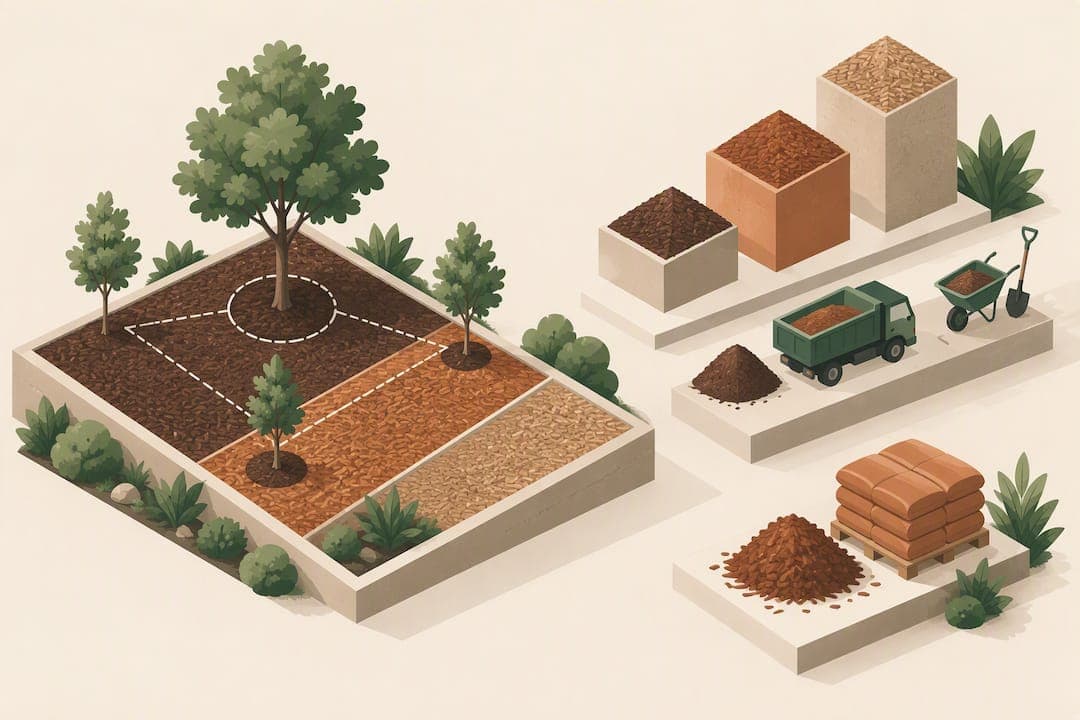
Expect about $30 to $60 per cubic yard for common organic mulches like shredded hardwood or bark, or roughly $3 to $6 per 2-cubic-foot bag at retail. Budget for a moderate range of material cost for a 100 square foot bed at 3 inches deep, not including delivery or installation, which are usually quoted separately.
TL;DR:
- Organic mulch prices vary from $30 to $60 per cubic yard, with dyed mulch costing more due to extra processing.
- A typical 100-square-foot bed at 3 inches deep requires less than one cubic yard, translating to a few bags depending on size.
- Delivery fees often depend on distance and minimum order quantities, while installation costs differ by method, with blown-in mulch being more expensive per yard.
- Proper mulch depth for plant health is 2 to 4 inches, with the 3-3-3 rule helping prevent trunk rot and pest issues in trees.
- Using a 3D planning tool can prevent estimation errors, showing real-time costs and quantities tailored to your property layout.
Table of Contents
- Material Cost Breakdown: Per Cubic Yard and Per Bag by Mulch Type
- How to Calculate How Much Mulch You Need
- Delivery, Installation, and Labor Costs That Add to the Quote
- Mulch Depth, the 3-3-3 Rule, and Plant Safety
- Ways to Cut Project Costs Without Sacrificing Plant Health
- Using a Planning Tool to Avoid Estimating Errors
- A Homeowner's Take on Mulch Budgeting
- Plan Your Mulch Project With Live Cost Estimates
- Sources
- FAQ
Material Cost Breakdown: Per Cubic Yard and Per Bag by Mulch Type
Mulch prices vary by material, processing, and how far it has to travel to reach you. Shredded hardwood and bark mulches, the most common choices for residential beds, typically run $30 to $60 per cubic yard in bulk or $3 to $6 per bag. Dyed or colored mulch costs more because of the extra processing step, usually $35 to $65 per yard. Wood chips, often the least processed option, can run cheaper, sometimes $20 to $45 per yard, especially when sourced locally. Rubber mulch sits at the high end, frequently $100 to $175 per yard, reflecting its manufactured origin and multi-year lifespan. Gravel and other inorganic ground covers vary widely by stone type and region, but often land between $40 and $110 per yard installed.
Several factors push these ranges up or down:
- Raw material cost shifts with regional lumber and forestry byproduct supply.
- Dyeing and screening add labor and equipment costs that bagged colored mulch passes on to buyers.
- Transport distance from the supplier's yard to your address affects bulk pricing more than bag pricing.
- Local availability of wood waste or municipal chip programs can undercut retail bagged prices significantly.
Organic mulches break down and need refreshing annually, while rubber or gravel can last 5 to 10 years or longer without replacement, according to guidance from the University of Tennessee Institute of Agriculture. That difference changes the math over time: a $40 per yard organic mulch replaced every year can cost more over five years than a $120 per yard inorganic option installed once, even though the sticker price looks worse at purchase.
How to Calculate How Much Mulch You Need
Getting the quantity right before you order is the single biggest way to avoid wasted money, either from overbuying material you don't use or underordering and paying a second delivery fee. The formula is straightforward:
- Multiply the bed's length in feet by its width in feet by the desired depth in inches, then divide by 12 to get cubic feet.
- Divide that cubic feet figure by 27 to convert to cubic yards, since a cubic yard equals 27 cubic feet.
- For bagged mulch, divide your total cubic feet by the bag size, most commonly 2 or 3 cubic feet, to get the number of bags needed.
- Add 5% to 10% extra to your final number to account for settling, uneven ground, and irregular bed shapes.
Here's the math for approximate quantities: for a 20 foot by 4 foot bed at 3 inches deep, the volume is under 1 cubic yard, equivalent to several bags depending on size. A small tree ring around 6 feet in diameter at this depth requires a fraction of a cubic yard, roughly a few bags.
Tools like the calculator from Backyard Buddy can run these conversions automatically if you'd rather skip the manual math, which is useful when you're juggling several beds of different shapes.

Delivery, Installation, and Labor Costs That Add to the Quote
Material price is only part of the bill. Delivery fees are often structured as a flat rate covering a set radius from the supplier's yard, sometimes with a minimum yardage requirement. Order less than that minimum and your per-yard cost jumps, since you're still paying the flat fee for a partial load.
Installation labor depends on method. Blown-in mulch, applied through a hose from a specialized truck, costs more per yard than hand spreading but covers large or hard-to-reach areas much faster, which can offset the higher rate on bigger jobs. Hand spreading suits smaller beds and tight spaces where a hose can't maneuver.
Other charges that show up on real quotes include:
- Old mulch removal and hauling, often billed separately from new material delivery.
- Tight-access surcharges for properties with stairs, narrow gates, or no truck access to the work area.
- Disposal or tipping fees if the crew hauls away debris to a landfill or composting site.
Pro Tip: Ask contractors for a line-item estimate that separates material, delivery, and labor, then combine multiple small beds into a single order to avoid paying several flat delivery fees in one visit.
Mulch Depth, the 3-3-3 Rule, and Plant Safety

Getting the depth right isn't just about looks. University extension guidance recommends 2 to 4 inches of mulch, with finer mulches at 2 to 3 inches and coarser material at 3 to 4 inches, according to the Kenosha County Extension. For trees specifically, the 3-3-3 rule is a useful shorthand: 3 inches of depth, keep mulch 3 inches clear of the trunk, and maintain a ring at least 3 feet in diameter, per Penn State Extension.
Piling mulch against the trunk, often called volcano mulching, traps moisture against the bark and invites rot, decay, and pest problems.
- Taper mulch away from the trunk so the root flare stays visible.
- Choose organic mulch when you want ongoing soil health benefits, but plan on yearly top-offs.
- Choose inorganic material for long-term weed suppression where soil improvement isn't the goal.
Ways to Cut Project Costs Without Sacrificing Plant Health
Bulk mulch generally beats bagged material once you need more than about 2 to 3 cubic yards, since bag prices carry retail packaging and handling markup. Watch for seasonal sales in spring and fall, when suppliers often discount bulk orders.
- Check municipal yard waste programs or local tree services for free or low-cost wood chips.
- Spread mulch yourself for small, accessible beds and hire a crew for large, sloped, or hard-to-reach areas.
- Aim for at least 3 cubic yards per delivery to spread the flat delivery fee across more material and lower your per-yard cost.
Using a Planning Tool to Avoid Estimating Errors
Manual measuring is where most mulch budgets go wrong, either from underestimating a bed's true area or forgetting to account for depth changes across a sloped yard. A 3D planning tool ties pricing directly to the objects in your layout, so when you adjust a bed's shape or change the mulch depth, the quantity and cost update automatically instead of requiring a fresh round of manual math.
- Useful for multi-bed properties where several shapes and materials need separate totals.
- Helpful for mixed-material borders combining mulch, gravel, and edging in one plan.
- Produces a document you can hand to a contractor showing exact quantities and projected costs.
A Homeowner's Take on Mulch Budgeting
Cheapest-per-bag rarely wins long term. Prioritize proper depth and a material that matches how often you're willing to reapply it. Bring in a pro when access, slope, or volume make the job impractical solo.
— Rokas
Plan Your Mulch Project With Live Cost Estimates
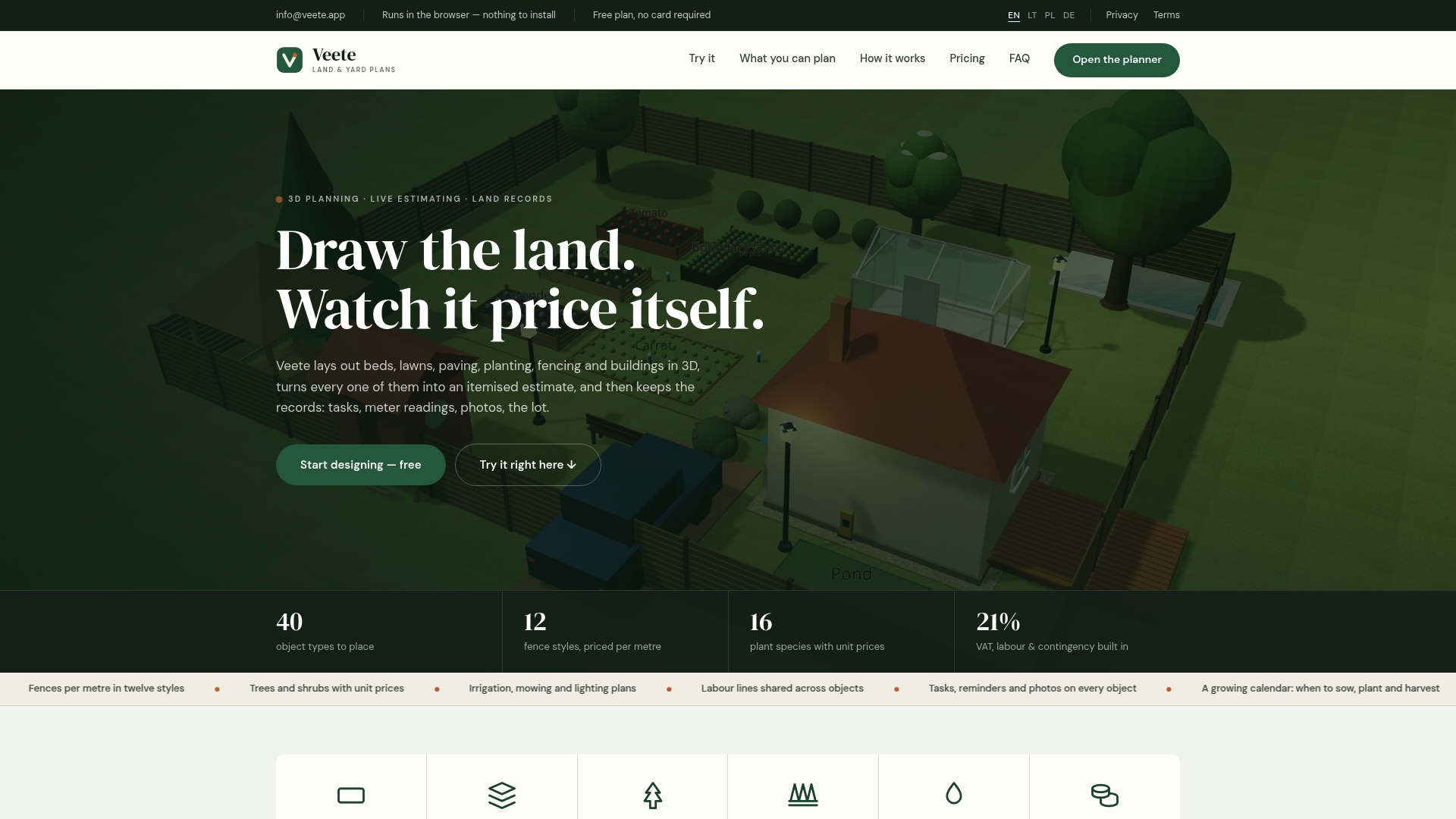
Guessing at square footage and hoping the delivery truck brings enough is how most mulch budgets get blown. Some 3D planning tools let you lay out your beds in 3D and see itemized, real-time pricing tied to every object in the plan, so changing a bed's depth or shape updates your material count and cost instantly instead of sending you back to a calculator.
- Map your beds and borders before you call a supplier or contractor.
- Start with the free plan to test a mulch estimate on your own property, no card required.
- Upgrade to a paid plan when you're ready to manage multiple projects or export contractor-ready documents.
Sources
For region-specific depth, species, or soil pH questions, check these publications or contact your local extension office directly:
- Are my trees buried too deep? | Penn State Extension
- Proper Mulch Techniques | Kenosha County Extension
FAQ
How much should 1 yard of mulch cost?
A cubic yard of common organic mulch like shredded hardwood or bark typically costs $30 to $60 in bulk, while dyed or colored mulch and specialty materials like rubber mulch can run higher. Delivery and installation are usually quoted separately from the material price.
What is the 3-3-3 rule for mulch?
The 3-3-3 rule calls for 3 inches of mulch depth, keeping mulch 3 inches away from the tree trunk, and maintaining a mulch ring at least 3 feet in diameter, according to Penn State Extension. Following this guideline helps prevent trunk rot and pest problems caused by piling mulch against the bark.
Who has mulch on sale 5 for $10?
Bagged mulch sale pricing varies by retailer, region, and season, and isn't something we track as a fixed figure. Check local home improvement or garden center promotions during spring and fall, when bagged mulch discounts are most common.
Who has cheaper mulch, Home Depot or Lowe's?
Pricing between national home improvement retailers shifts by location, season, and promotional timing, so neither consistently beats the other everywhere. Compare current bag prices at your nearest stores and factor in any bulk delivery minimums before deciding.
How do I know how many bags of mulch I need?
Calculate your bed's cubic feet by multiplying length, width, and depth in inches, then dividing by 12, and divide that result by your bag size, typically 2 or 3 cubic feet.