
Multi-project management is the discipline of planning, sequencing, and staffing several concurrent projects that draw on the same pool of people, budget, and time. If you run more than two active projects with shared team members, your first move should be a single centralized project inventory paired with one prioritization rule, applied consistently before you touch tools or org charts.
TL;DR:
- Coordinating more than two active projects requires a centralized inventory and a consistent prioritization rule to prevent resource conflicts and delays.
- Advanced scheduling models like hybrid heuristics and flexible resource management improve project delivery and resource utilization under uncertainty.
- Building a shared dashboard that consolidates project status, risks, and capacity helps identify bottlenecks and conflicts early.
- Using a pilot approach with clear KPIs, such as delivery rate and resource utilization, allows organizations to tailor multi-project management practices effectively.
- Culture matters; organizations that promote transparency, respect shared priorities, and support escalation pathways maximize multi-project management success.
Table of Contents
- What multi-project management is and how it differs from program and portfolio management
- Why multi-project management matters for delivery and resources
- Core challenges in managing multiple projects
- Frameworks and strategies to coordinate multiple projects
- Scheduling and resource allocation under uncertainty
- Tools, dashboards, and coordination practices that scale
- How to implement multi-project management step by step
- Risk management strategies specific to multi-project environments
- Stakeholder management and communication across projects
- How organizational culture shapes multi-project outcomes
- Integrating multi-project management with agile and hybrid methods
- Common pitfalls and how to avoid them
- Author perspective: resilient MPM for modern teams
- An adjacent tool for keeping project-level plans and costs aligned
- Sources
- FAQ
What multi-project management is and how it differs from program and portfolio management
Multi-project management (MPM) means coordinating multiple, often unrelated, projects that compete for the same resources at the same time. It applies whenever one team, one manager, or one department has to split attention and staff across parallel efforts rather than running a single initiative start to finish.
MPM is frequently confused with program and portfolio management, but the scope is different. A program groups related projects that share a common goal, such as a product launch that includes engineering, marketing, and legal workstreams. A portfolio is a higher-level collection of programs and projects selected and funded to match business strategy. MPM sits underneath both: it is the operational layer where a project manager juggles the day-to-day scheduling, staffing, and reporting for several efforts, related or not. PMBOK guidance frames this as a matter of tailoring practices and performance domains to context rather than following one fixed method, which is exactly why MPM looks different from one organization to the next.
You likely need a deliberate MPM approach if you recognize any of these signs:
- Team members are assigned to three or more active projects and regularly report being blocked waiting on each other.
- Deadlines slip on projects that individually look healthy, because a shared resource became the bottleneck.
- Status updates live in different documents, chats, or spreadsheets, and nobody has one place to see everything at once.
Once two or more of these show up together, ad hoc coordination stops working and you need a structured system.
Why multi-project management matters for delivery and resources
The case for MPM is practical, not theoretical. When projects share people, budget, and equipment, every scheduling decision on one project changes what is available on another. Treating them as fully separate efforts, each with its own plan, guarantees conflicts that surface late and cost more to fix.
Done well, MPM optimizes resource use by matching capacity to actual demand instead of assuming every project has dedicated staff. It improves alignment because a shared inventory of work forces explicit prioritization instead of whoever asks loudest getting attention first. It also improves delivery predictability: when you know which projects are truly resourced and which are waiting, you can commit to dates with more confidence.
Advanced scheduling models and hybrid optimization methods have been shown to improve resource utilization and reduce project durations in complex engineering environments compared with manual scheduling approaches. That gap between structured scheduling and manual juggling is the core productivity argument for MPM: the same people can deliver more when their time is allocated deliberately rather than reactively.
PMBOK's emphasis on aligning projects to organizational value applies directly here. A project that looks successful in isolation, on time, on budget, can still be a poor use of resources if it pulled capacity away from higher-value work. MPM makes that trade-off visible instead of hiding it inside separate project plans, which is what lets a project manager argue for a rebalance before it becomes a crisis rather than after.
Core challenges in managing multiple projects
Most multi-project problems trace back to a handful of recurring patterns. Naming them helps you diagnose which one is actually hurting your delivery before you reach for a new tool or process.
Resource contention and shared-role overload top the list. When a designer, a database administrator, or a single subject-matter expert is booked across four projects, that person becomes the constraint for all four, whether or not their calendar shows it clearly.
Context switching compounds the problem. Every time someone jumps from one project's context to another, they lose time reorienting, and Microsoft's research on context switching finds this kind of fragmented attention measurably hurts productivity, especially for knowledge work that requires sustained focus.
Hidden dependencies create the most painful failures because they surface only when something breaks. Project A quietly depends on an output from Project B, nobody flagged it in either plan, and the delay cascades before anyone notices the link.
Outdated documentation and conflicting priorities finish the list. When each project keeps its own status doc and its own definition of "urgent," two managers can each believe their project is top priority, and both can be right by their own local rules.
Watch for these anti-patterns, which tend to appear together:
- Resource assignments tracked only in individual project plans, with no cross-project view of who is actually available.
- Priorities set project-by-project instead of ranked against each other on one shared list.
- Status meetings that report progress but never surface capacity conflicts until a deadline is already at risk.
Pro Tip: Before adding any new tool, spend a week just listing every project each team member is currently assigned to. The overlap alone usually reveals your biggest bottleneck.
Frameworks and strategies to coordinate multiple projects
A small set of proven methods covers most of what multi-project teams need. None of them requires new software, and most can start this week.
- Adopt a prioritization framework. A weighted scoring model, ranking projects by criteria like strategic value, urgency, and resource cost, gives you a defensible order when two projects both claim to be top priority. A simpler value-versus-urgency matrix works for smaller teams that do not need formal scoring.
- Limit work in progress. Cap the number of active projects any single person or team can carry at once. Capacity-led scheduling, starting new work only when current work finishes or frees up capacity, prevents the overcommitment that causes resource contention in the first place.
- Build a single source of truth. One centralized database of every active project, its owner, its status, and its resource needs replaces scattered spreadsheets and separate status docs. Atlassian's guidance on project coordination points to this centralization as the step that most reduces manual overhead for teams juggling several efforts at once.
- Standardize templates and lightweight gates. A shared project brief template, a common status report format, and a simple go/no-go checkpoint before major phases cut down on the reinvention that eats time on every new project.
- Introduce a coordination role when volume justifies it. A PMO or dedicated coordinator makes sense once you are running enough concurrent projects that keeping the shared inventory current becomes a job in itself, not a side task for whoever has time.
- Run retrospectives across projects, not just within them. A lessons-learned review that looks at patterns across your whole project set, not just one project's postmortem, catches the resourcing and dependency issues that repeat quarter after quarter.
Not every organization needs all six at once. A five-person team might only need steps one through three; a fifty-person department juggling a dozen projects will likely need all of them, plus the governance layer described later in this guide. Northeastern's research on project management strategies makes the same point: no single methodology fits every context, and the right combination depends on your team's size, project mix, and tolerance for formal process.
Scheduling and resource allocation under uncertainty
Most multi-project plans are built as if the future is known: task durations are fixed, resources are available exactly when scheduled, and nothing changes. Reality rarely cooperates, and that gap is what the academic literature on the Resource-Constrained Multi-Project Scheduling Problem, or RCMPSP, has spent years studying.
RCMPSP treats scheduling as an optimization problem where several projects compete for a limited pool of resources, and it explicitly models what happens when durations, availability, or priorities shift mid-schedule. A narrative review of RCMPSP research covering 2013 to 2024 finds that flexible resource management and hybrid heuristics, combinations of rule-based and optimization-based methods, consistently increase scheduling robustness compared with rigid, fully deterministic baseline schedules. In plain terms: a schedule built to survive change outperforms one built to be perfect on day one.
One of the more practical findings from this research concerns priority rules, simple heuristics that decide which task or project gets a resource first when there is a conflict. An experimental study on priority-rule performance in dynamic, stochastic multi-project environments found that a rule called W(CR+SPT), Weighted Critical Ratio combined with Shortest Processing Time, consistently outperformed other tested rules for minimizing weighted project tardiness across a range of settings.
W(CR+SPT) consistently performs best for minimizing weighted project tardiness across many settings tested. Experimental study comparing priority rules in dynamic stochastic multi-project scheduling
That rule works by favoring tasks that are both urgent relative to their remaining slack (critical ratio) and quick to finish (shortest processing time), weighted by project importance. You do not need custom software to apply the underlying logic: when two tasks compete for the same person, give the edge to the one with less slack and less remaining work, adjusted for how much that project matters to the business.
| Approach | What it does | Best fit |
|---|---|---|
| Deterministic baseline schedule | Fixes durations and resources in advance | Stable projects with few unknowns |
| RCMPSP with flexible resources | Allows resource profiles to shift as conditions change | Multi-project settings with resource sharing |
| W(CR+SPT) priority rule | Ranks competing tasks by urgency and duration, weighted by importance | Dynamic environments needing fast, repeatable decisions |
| Hybrid heuristic methods | Combines rule-based logic with optimization for harder cases | Larger portfolios with complex dependencies |
The ScienceDirect review of resource-constrained multi-project scheduling explains why heuristics dominate in practice rather than exact optimization: RCMPSP is computationally expensive to solve exactly, so most organizations rely on rules and hybrid methods that are fast enough to rerun as conditions change.
For a practitioner without a scheduling engine, three heuristics translate this research into action. First, re-prioritize dynamically rather than locking a schedule at project kickoff, since conditions that justified an original order rarely hold for the life of a multi-month portfolio. Second, build in buffers on the resources most likely to be shared across projects, not just on individual task estimates. Third, if you are considering algorithmic or rule-based scheduling tools, pilot them on a small subset of projects before rolling them out portfolio-wide, since the FRCPSP research on flexible resource profiles shows benefits vary by how volatile your actual project mix is.
Tools, dashboards, and coordination practices that scale
The right dashboard turns a pile of separate status reports into one decision-making surface. At minimum, a cross-project view needs four fields: project health (on track, at risk, blocked), key risks with an owner attached, a resource capacity view showing who is booked where, and a prioritized backlog so new requests land in order rather than by whoever asked most recently.
Automated reporting creates the biggest time savings in exactly the places manual updates are most likely to go stale: status rollups, resource utilization percentages, and dependency flags between projects. Atlassian's coordination guidance notes that centralizing plans and automating this kind of reporting frees project managers to spend time on decisions instead of data entry, which is the real payoff of tooling investment.
Coordination roles use these same tools differently than individual project managers do. A PM looks at their own project's dashboard to manage tasks and risks. A coordinator or PMO looks across every project's dashboard at once, watching for the resource conflicts and priority clashes that no single project view can show.
A few integration patterns cover most of what teams need without heavy custom engineering:
- Automated status syncs that pull task completion data from individual project tools into one shared dashboard, rather than requiring manual copy-paste updates.
- Escalation rules that flag a project as at-risk automatically when a dependency slips past its deadline, instead of waiting for the next status meeting.
- A shared calendar or capacity view that shows resource bookings across all active projects in one place, so a new project request can be checked against real availability before it is approved.
Start with whichever of these closes your biggest visibility gap. Most teams find the resource capacity view delivers the fastest payoff, since it is usually the piece missing from individual project plans.
How to implement multi-project management step by step
Rolling out MPM works best as a bounded pilot, not a company-wide mandate on day one. A four to twelve week pilot gives you enough data to prove the approach works before you scale it.
- Build a single project inventory in week one. List every active project, its owner, its priority, and everyone assigned to it, even part-time, in one shared document or tool.
- Apply one prioritization rule immediately. A simple weighted score or a value-versus-urgency ranking is enough to start; refine it later once you see how it performs.
- Define capacity limits per person or team. Set a maximum number of concurrent projects per person and stop assigning new work past that cap until something finishes or frees up.
- Run the pilot for four to twelve weeks. Pick a handful of representative projects, apply the inventory, the prioritization rule, and the capacity limits, and track what changes.
- Assign clear roles and a reporting cadence. Decide who owns the shared inventory, who resolves resource conflicts, and how often the cross-project dashboard gets reviewed, weekly is typical for active portfolios.
- Select three KPIs and track them consistently. On-time delivery rate, resource utilization, and lead time from request to project start cover the outcomes that matter most in a multi-project setting.
- Run a retrospective at the end of the pilot. Ask what the prioritization rule got right, where capacity limits were too tight or too loose, and which dependencies still surfaced late.
- Scale what worked and adjust what did not. Extend the successful patterns to more projects, refine the prioritization criteria based on pilot data, and repeat the retrospective cadence quarterly.
Pro Tip: Pick your three KPIs before the pilot starts, not after. Choosing metrics retroactively almost always biases them toward whatever happened to go well.
The PMI article on strategic planning for projects reinforces why the pilot structure matters: alignment across projects improves outcomes, but only when it is tailored to the organization's actual constraints rather than copied wholesale from another team's process. A pilot lets you find that fit before committing.

Risk management strategies specific to multi-project environments
Risk in a multi-project setting rarely stays contained to one project. A delay, a resource loss, or a budget cut on one initiative can ripple into every other project sharing its people or funding, which means risk registers built project-by-project miss the interactions that matter most.
The fix is a shared risk view alongside individual project risk logs. Track cross-project risks separately, resource dependency, shared vendor delays, key-person availability, and review them at the portfolio level, not inside any single project's status meeting.
Buffers help more than contingency plans written after the fact. Building schedule and resource slack around the people and roles most shared across projects absorbs shocks before they cascade, which lines up with the RCMPSP research showing flexible resource approaches outperform rigid plans under uncertainty.
Escalation paths need to be explicit too. When a shared resource risk appears, who decides which project gets priority? Without a pre-agreed answer, that decision gets made informally, usually by whoever escalates loudest, which is rarely the right call for the organization as a whole.
Stakeholder management and communication across projects
Stakeholders in a multi-project environment often have visibility into only their own project, which means they judge delays or resourcing decisions without seeing the tradeoffs happening elsewhere. Closing that gap is most of what cross-project communication needs to do.
A shared status format helps here more than any single tool choice. When every project reports health, risk, and resourcing the same way, a stakeholder who sponsors two projects can compare them at a glance instead of translating between two different report styles.
Communication cadence matters as much as format. A monthly cross-project review, separate from individual project status meetings, gives stakeholders and sponsors a chance to see resource conflicts and priority tradeoffs before they become emergencies, rather than being surprised by a reprioritization after the fact.
Setting expectations early avoids most conflict later: telling a stakeholder up front that their project may be deprioritized if a higher-value initiative needs the same resource is far easier than explaining a missed deadline after it happens.
How organizational culture shapes multi-project outcomes
The best prioritization framework fails in a culture where every request is treated as urgent regardless of what the framework says. Multi-project management depends on people actually respecting the shared priority order, and that willingness is a cultural trait, not a process one.
Organizations that reward visible busyness over completed priorities tend to undermine their own MPM systems: team members overcommit to look responsive, and the capacity limits meant to protect delivery get quietly ignored. A culture that instead rewards saying no to lower-priority work, and backs that decision with management support, is what makes WIP limits and prioritization rules stick.
Transparency plays a similar role. Teams that are comfortable surfacing a resource conflict early, rather than hiding it until a deadline is at risk, give the whole system a chance to rebalance before damage is done. That comfort usually traces back to whether raising a problem gets treated as useful information or as a complaint.
None of the frameworks in this guide work without that underlying trust. A weighted prioritization score is only as good as the organization's willingness to actually follow it when the ranking is inconvenient.
Integrating multi-project management with agile and hybrid methods
Multi-project management is not a competing methodology to Agile or Scrum. It operates at a different layer, coordinating resources and priorities across projects, while Agile frameworks govern how work happens inside any single project or team.
Teams running Scrum on individual projects still need an MPM layer above their sprints to decide which project gets a shared engineer this sprint versus next. Sprint planning inside one team cannot resolve a resource conflict with another team's sprint, since that decision sits at the portfolio level, not the team level.
Hybrid organizations, running Agile on some projects and Waterfall-style phased delivery on others, actually benefit from MPM more than single-methodology shops, because a shared prioritization rule and centralized inventory give both project types a common language for resource requests. Without that shared layer, an Agile team's two-week sprint cadence and a Waterfall project's quarterly milestone reviews end up competing for the same people with no consistent way to arbitrate.
The practical adjustment is timing: sync your cross-project prioritization review to whichever cadence is shortest among your active projects, typically the Agile sprint cycle, so resource decisions do not lag behind the fastest-moving work.
Common pitfalls and how to avoid them
The most frequent mistake is skipping the inventory step and jumping straight to a tool. A sophisticated dashboard populated with incomplete or outdated project data is worse than a simple spreadsheet that everyone actually keeps current.
A second common pitfall is setting a prioritization rule once and never revisiting it. Priorities shift as business conditions change, and a ranking from six months ago can quietly misallocate resources if nobody checks whether it still reflects reality.
Overloading a new coordinator role with too much authority too fast also backfires. A coordinator who starts reassigning resources without buy-in from project managers creates resistance that undermines the whole system, even when the reassignment is correct.
Finally, teams often mistake reporting for action. A dashboard that shows a resource conflict clearly but has no defined process for resolving it just makes the problem visible without fixing it. Visibility only helps when it is paired with an actual escalation path and someone empowered to make the call.
Author perspective: resilient MPM for modern teams
The research on RCMPSP and priority rules points to a conclusion that matters more than any single technique: a schedule built to survive change beats a schedule built to be perfect. Most project managers still default to detailed baseline plans, then treat every deviation as a failure to manage rather than something the plan should have expected.
That instinct is backward. Governance should protect the few things that truly need rigor, budget approval thresholds, safety-critical gates, and stay light everywhere else. A prioritization rule you revisit monthly beats a five-year resourcing model you never touch. Teams that treat their multi-project system as something to test and adjust, the way the pilot approach in this guide works, end up more resilient than teams that spend months designing the perfect process before running it once.
Measure what you can, keep the framework simple enough that people actually use it, and expect to be wrong about your first prioritization rule. That is not a failure of planning. It is what planning under real uncertainty looks like.
— Rokas
An adjacent tool for keeping project-level plans and costs aligned
Landscaping and construction-adjacent projects carry their own version of the multi-project coordination problem: a design change on one job site changes material quantities, labor estimates, and costs all at once, and if those updates do not sync automatically, rework and mismatched estimates follow.
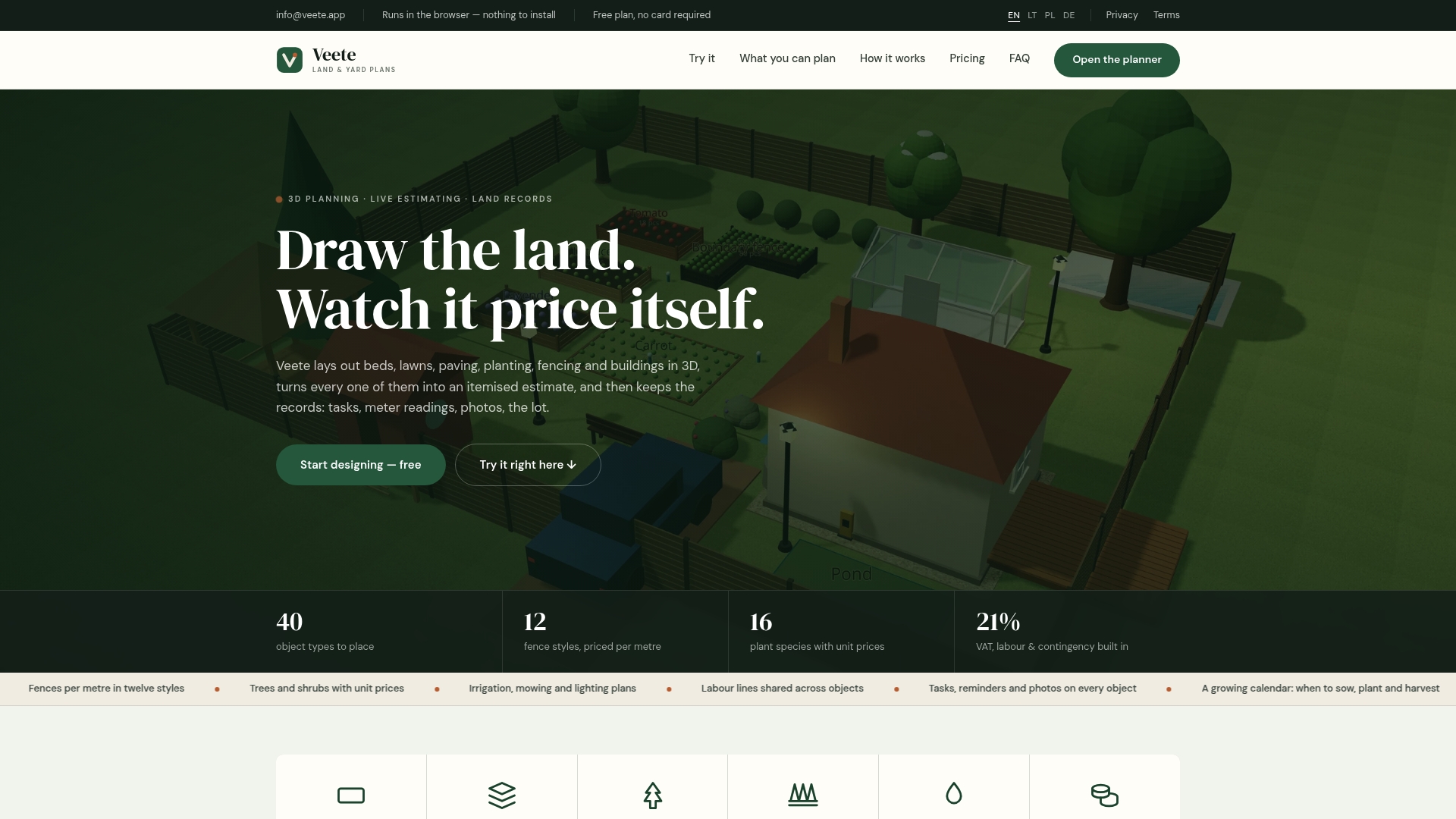
Veete addresses that specific gap for landscaping and gardening projects. It is a browser-based 3D planning tool where every bed, lawn, path, or structure carries pricing linked directly to the object itself, so adjusting a design updates materials, quantities, and costs together instead of requiring a manual re-measurement. For a landscaper or contractor running several client projects at once, that synchronization removes one of the recurring sources of coordination overhead: mismatched estimates between what was designed and what was quoted.
Veete offers a free plan with no card required, alongside paid tiers with additional features for teams managing multiple client projects. You can check current plan details on the Veete pricing page or start with the free plan on the Veete landing page.
Sources
- Springer article on hybrid intelligent optimization for scheduling (2026)
- Project coordination guidance — Atlassian
FAQ
What does "multi-project management" mean?
Multi-project management means planning, staffing, and tracking several concurrent projects that share the same people, budget, or resources. It differs from managing one project because every scheduling decision on one project can affect availability on another.
What are the 7 types of project management?
Definitions vary across sources, but common methodologies discussed in project management literature include Waterfall, Agile, Scrum, Kanban, Lean, Six Sigma, and Critical Path Method. The right choice depends on project size, uncertainty, and organizational context rather than a fixed ranking of types.
What is the 80/20 rule for project managers?
The 80/20 rule, or Pareto principle, suggests that roughly 80% of results come from 20% of effort or causes, which project managers use to focus attention on the highest-impact risks, tasks, or stakeholders. In multi-project settings, this often means identifying the small number of shared resources or dependencies causing most of the delays.
What is the best way to organize multiple projects?
Start with a single centralized inventory listing every active project, its owner, and its resource needs, then apply one prioritization rule consistently across all of them. Adding a shared dashboard for project health and resource capacity, as recommended in Atlassian's project coordination guidance, further reduces the manual overhead of tracking everything separately.