
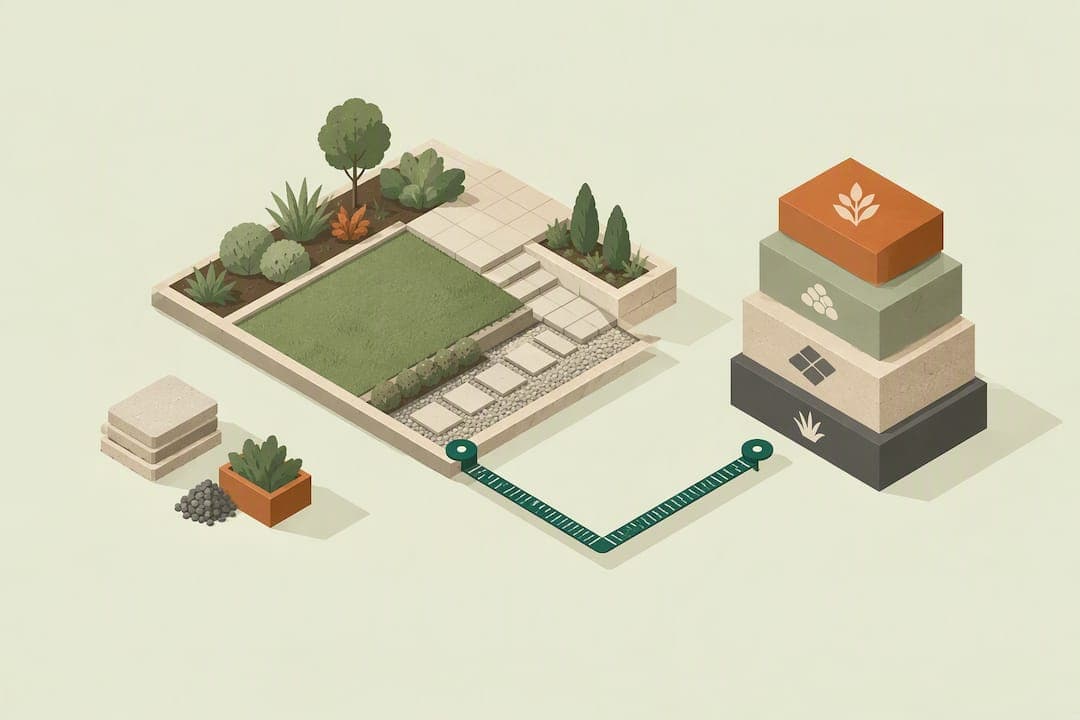
Most homeowners pay an hourly rate for landscaping labor generally in the typical range for the industry, or a total cost in the thousands of dollars for defined projects like sod installation or a paver patio. The spread comes down to three things: what kind of work you need (routine mowing versus a full hardscape build), how complicated your site is (slope, access, existing plant removal), and what materials you choose. The rest of this guide breaks those numbers down by service, by pricing model, and by what a fair contract should actually say.
TL;DR:
- Landscaping labor costs vary significantly by region, averaging around $51 per hour nationally, but can be $20 to $30 higher in expensive cities.
- Routine maintenance services are usually priced per visit with flat rates, while larger projects like sod installation or hardscapes are quoted as fixed prices based on detailed unit measurements.
- The main cost driver in bids is labor, which includes site measurement, production rates, equipment, waste, and burdened labor costs, often making up the largest part of the quote.
- Site conditions such as access issues, steep slopes, poor soil, and hidden underground utilities can substantially increase project costs.
- Getting clear, detailed quotes with scope, timeline, exclusions, payment, and change procedures helps prevent cost overruns and ensures estimates align with final bills.
Table of Contents
- Pricing Landscaping Services: Typical Rates You Can Sanity-Check
- Cost By Service: What Each Job Actually Runs
- Which Pricing Model Is Your Contractor Actually Using?
- How Landscapers Actually Build Their Numbers
- What Pushes a Quote Higher Than You Expected
- Getting a Quote and Contract You Can Actually Trust
- Closing the Gap Between a Quote and the Final Bill
- The Real Trade-Off: Cost, Durability, and Schedule
- Try Before You Hire: Plan Your Project in 3D First
- Where These Numbers Come From
- Sources
- FAQ
Pricing Landscaping Services: Typical Rates You Can Sanity-Check
National marketplace data puts the average hourly landscaping rate around $51 per hour in the United States, though that number swings hard by region and by whether you're hiring a solo operator or a licensed crew with insurance and equipment overhead baked in. City rates in expensive metro markets often run $20 to $30 higher per hour than rural or small-town rates for the same job.

Routine maintenance, mowing, edging, blowing, tends to get priced per visit rather than by the hour, because a crew can quote a flat rate once they've seen your lot size. Here's the math a lot of companies actually use behind the scenes: if a two-person crew bills at $60 combined hourly and the job takes 45 minutes, that's a $45 visit charge before any markup for drive time or fuel. Multiply that by weekly visits across a 30-week season and you're looking at $1,350 to $1,800 a year just for mowing.
Hourly pricing shows up most often for:
- Small, undefined jobs like cleanup, pruning, or one-off debris hauling
- Work where scope could change once the crew is on-site (unknown soil conditions, hidden root systems)
- T&M arrangements on larger projects where design decisions are still in flux
Fixed per-job or per-visit pricing dominates once a service is standardized. Mowing, fertilization treatments, and seasonal cleanups almost always get quoted as flat packages because both sides want cost predictability. Lawn care guides show monthly maintenance packages commonly landing in the $100 to $300 range depending on lot size and treatment frequency, a useful number to hold against any quote you're comparing.
Cost By Service: What Each Job Actually Runs
Pricing changes dramatically depending on what you're asking for, so comparing "landscaping cost" as one number is close to meaningless. Break it down by service and the picture gets a lot clearer.
Routine and seasonal services:
- Mowing: $50 to $200 per visit depending on lot size and terrain
- Aeration and overseeding: $75 to $400 for an average residential lawn
- Fertilization programs: $50 to $100 per application, often sold in 4 to 6 round packages
- Sod installation: $1 to $2 per square foot including prep, pushing higher on sloped or rocky sites
Bigger, less frequent projects:
- Irrigation system installation: $2,500 to $6,000 for a standard suburban lot
- Tree removal or major pruning: $200 to $1,500 depending on tree size and access
- Small hardscape additions, like a modest paver patio: $10 to $25 per square foot installed
A worked example helps more than a range does. Say you want 500 square feet of sod replaced. At $1.50 per square foot, that's $750 in materials and installation labor. Add a $150 disposal fee for the old dead turf and a $100 delivery charge for pallets, and your "sod job" quote lands closer to $1,000, not the $750 sticker price you might have mentally budgeted.
The recurring versus one-time distinction matters for your budget planning, too. Mowing and fertilization are ongoing line items you should treat like a utility bill. Sod, irrigation, and hardscape are capital costs, closer to a home improvement than a service contract, and they deserve their own line in a yearly budget rather than getting lumped in with weekly lawn care.
Which Pricing Model Is Your Contractor Actually Using?
Every landscaping quote is built on one of five pricing models, and knowing which one you're looking at tells you where the financial risk sits.
- Hourly: You pay for time worked, plus materials. Fair for undefined scope, risky for you if the job runs long.
- Lump-sum (flat fee): One price for the whole job regardless of hours. Predictable for you, but only as good as the scope definition behind it.
- Unit-price: Priced per square foot, linear foot, or cubic yard. Common for sod, pavers, and mulch, and it makes change orders easy to price fairly.
- Package pricing: Bundled recurring services (mow plus fertilize plus cleanup) sold as one monthly rate.
- Time and materials (T&M): Hourly labor plus itemized material costs, typically used when the scope might shift mid-project.
Lump-sum pricing feels safest to homeowners because the number won't move, but it only protects you if the written scope is airtight. A vague lump-sum contract lets a contractor cut corners on hours or upsell you the moment anything unexpected turns up. Unit-price bidding, by contrast, keeps everyone honest because both sides agreed to a rate per square foot or per plant before the shovel hit the dirt.
Pro Tip: Ask for a not-to-exceed (NTE) cap on any hourly or T&M quote. It gives you the flexibility of time-based pricing with the ceiling protection of a lump-sum bid.

How Landscapers Actually Build Their Numbers
Behind every legitimate quote is a process called a takeoff, and understanding it turns you from a passive price-shopper into someone who can spot a lazy estimate from across the room.
- Measure the job in units. A contractor walks your property and counts everything in square feet (lawn area, patio space), linear feet (edging, fencing), cubic yards (mulch, soil), or individual counts (trees, shrubs, plants). This is the takeoff, and it's the foundation every serious bid stands on.
- Apply production rates. Each unit has a known crew-hour cost. A trained two-person crew can typically lay a set number of pallets of sod per hour or install a set linear footage of edging per hour. These production rates, refined over years of jobs, are what separate an experienced estimator from someone guessing.
- Calculate burdened labor. This is the real hourly cost of a worker once you add payroll taxes, insurance, and benefits on top of the wage they're paid. A crew member earning $22 an hour might actually cost the company $30 to $34 an hour once burdened, and that gap is exactly why a homeowner comparing "my neighbor's guy" hourly rate to a licensed company's rate is comparing two different things.
- Add equipment and waste factors. Mowers, skid steers, and delivery trucks all cost money to run and depreciate, so a competitive quote allocates an hourly equipment rate on top of labor. Material waste, extra pavers for cuts, extra sod for odd angles, gets built in too, often 5% to 10% over the measured quantity.
Here's a simplified version of the math: 300 square feet of patio pavers, at a production rate of 40 square feet per crew-hour, means 7.5 crew-hours of labor. At a burdened rate of $65 per crew-hour, that's roughly $490 in labor alone, before materials, equipment time, or profit margin. Industry benchmark data consistently shows labor as the single largest, most variable cost in any landscaping bid, which is exactly why a quote that skips the labor math and just gives you a round number should raise questions.
What Pushes a Quote Higher Than You Expected
Contractors don't pad prices arbitrarily. Certain site conditions genuinely cost more to work around, and knowing them lets you flag issues before a bid instead of arguing about them after.
- Access problems: A backyard reachable only through a narrow side gate means everything gets moved by hand instead of by machine, which slows a crew down dramatically.
- Slope and drainage: Steep grades require more labor, sometimes retaining structures, and complicate equipment use.
- Poor soil: Clay-heavy or rocky soil can turn a simple planting job into an amendment and excavation project.
- Existing irrigation or utilities: Unknown sprinkler lines or buried cable often surface mid-job and stall progress.
- Permits: Larger hardscape or drainage work may need a municipal permit, adding cost and time.
- Hidden removal work: Old dead shrubs, tree stumps, or a failing retaining wall frequently aren't priced into an initial walk-through quote.
Photograph your property from multiple angles and note anything unusual, slopes, gate widths, existing structures, before you request bids. A topographic survey is worth considering for larger installs where grading and drainage matter, since accurate site measurements prevent costly surprises once work begins. Also check that every quote explicitly states who pays for disposal, delivery, and permit fees. Those three line items are where "cheap" quotes quietly turn expensive.
Getting a Quote and Contract You Can Actually Trust
A good quote reads like a checklist, not a paragraph. Here's what has to be in writing before you sign anything:
- Detailed scope: Exact tasks, quantities, and materials or brand names specified, not just "install patio."
- Timeline: Start date, estimated duration, and what happens if weather delays the schedule.
- Exclusions: What's explicitly not included (permit fees, tree removal, irrigation repair).
- Payment schedule: Deposit amount, milestone payments, and final payment terms.
- Change-order procedure: A written process for pricing and approving anything added mid-job.
To compare bids fairly, normalize them. If one contractor quotes a lump sum and another gives you a per-square-foot unit price, ask the lump-sum bidder for their unit breakdown too. You can't compare $4,000 against $4,500 meaningfully until you know both cover the same square footage and the same material grade.
Consumer protection guidance from California's licensing board recommends getting at least three bids, verifying license and insurance status, and keeping any upfront deposit small relative to the total job cost.
Pro Tip: Never pay more than a small deposit before work starts. A contractor who insists on being paid in full upfront is shifting all the financial risk onto you.
Closing the Gap Between a Quote and the Final Bill
Most cost overruns don't come from bad contractors, they come from scope that was never nailed down in the first place. A 3D planning tool like Veete lets you define exactly what you want, bed shapes, paver square footage, plant counts, before a single quote comes in.
- Live pricing updates automatically when you resize a patio or swap a plant, so you see the cost impact of a design change in real time instead of after a change order.
- Itemized takeoffs and shopping lists give you the same unit-level detail a professional estimator builds, which makes comparing contractor bids far easier.
- Homeowners can use it to plan before ever calling a contractor, or alongside a hired crew to keep everyone working from the same numbers.
The goal isn't replacing your landscaper. It's walking into that first conversation with a scope so clear that the quote you get back matches the bill you eventually pay.
The Real Trade-Off: Cost, Durability, and Schedule
Homeowners chase the lowest bid more often than they should, but the cheapest quote is usually cheap because the scope is vague, not because the contractor found a shortcut. Clarity on materials and quantities protects you more than any single price comparison ever will.
Build a 10% to 15% contingency into any project budget, and ask every bidder for an itemized breakdown, not a round number. A quote that can't show its math usually can't defend its price either.
— Rokas
Try Before You Hire: Plan Your Project in 3D First
Veete gives you a way to price out a landscaping project before a single contractor sets foot on your property, with live estimates tied directly to the beds, lawn, and structures you design. Instead of guessing at square footage or hoping a verbal quote holds up, you build the plan, see the itemized cost update in real time, and walk into contractor conversations with numbers you can defend.
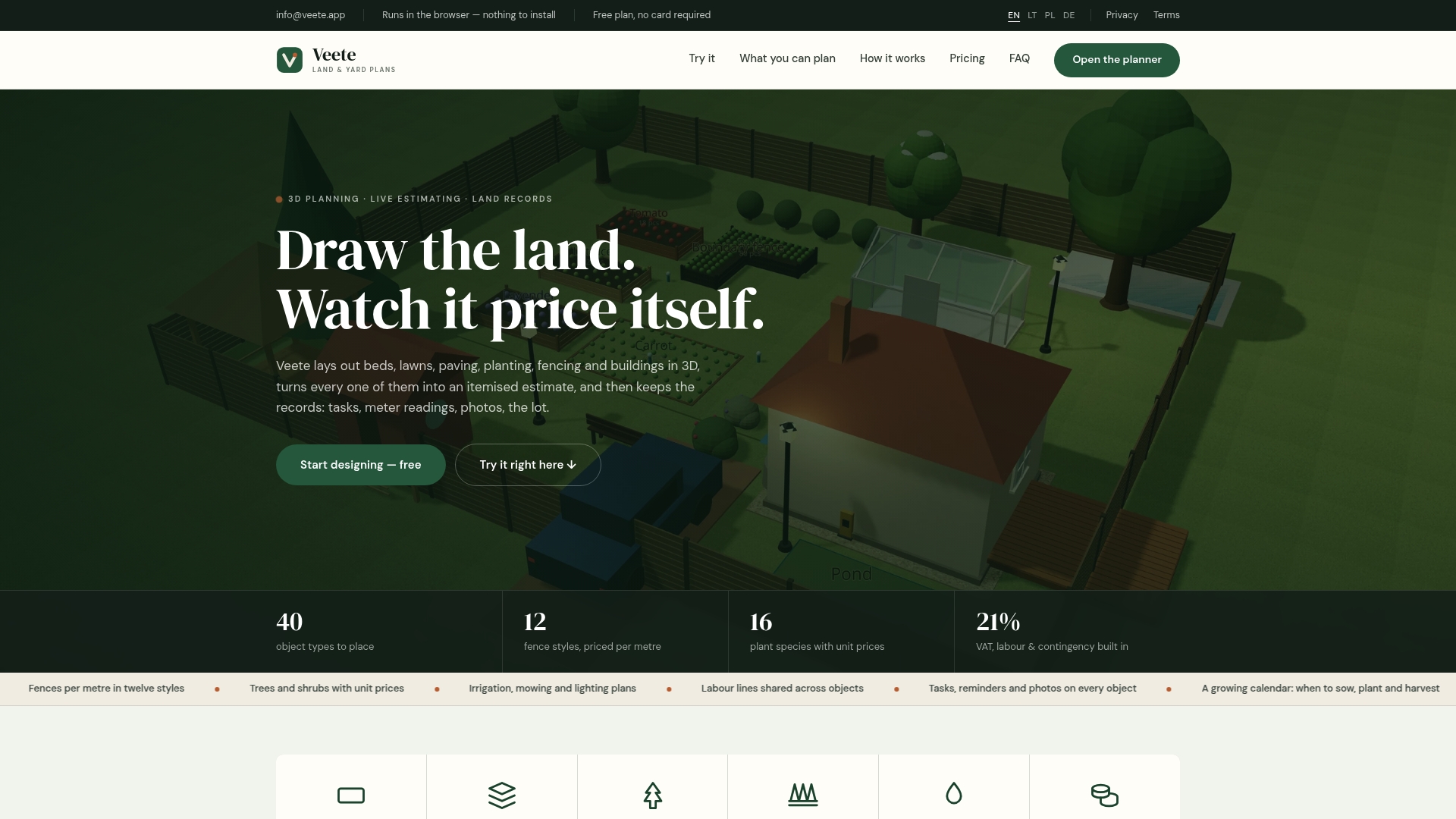
Homeowners planning a smaller project can start on the Free plan with no card required, while the Home plan runs $48 per year for ongoing access to full project tools. Property managers juggling multiple sites may prefer the Pro plan at $168 per year, which supports multiple projects and export features for client handoff. Head to Veete to build your first layout and see what your project actually costs before you request a single bid.
Where These Numbers Come From
Cross-checking any quote against outside sources takes ten minutes and can save you hundreds of dollars.
- Bureau of Labor Statistics: Check grounds maintenance worker wage data to confirm local labor cost baselines.
- State contractor licensing boards: Verify a contractor's license and insurance status before signing anything.
- Industry benchmark reports: Sources like the NALP financial benchmark report show real margin and cost-driver data across the industry.
Sources
- How Much Does Landscaping Cost? (Taskrabbit)
- How Much Does Lawn Care Cost in 2026? (LawnStarter)
- Landscape estimating and bidding field guide for contractors (Anvilfield)
- Choosing a landscape contractor (CSLB)
FAQ
Is $100 an Hour Too Much for Landscape Work?
Not necessarily. National averages sit closer to $51 per hour, but $100 an hour can be reasonable in high-cost metro areas or for specialized work like tree removal, hardscape installation, or licensed irrigation repair. Always ask what's included at that rate, materials, equipment, and disposal can all be bundled into a higher hourly figure.
How Do You Price Landscaping Services Fairly?
Fair pricing starts with a takeoff, measuring the job in square feet, linear feet, or plant counts, then applying a production rate and a burdened labor cost rather than guessing at a flat number. Tools like Veete let homeowners build that same itemized breakdown themselves before comparing it against contractor bids.
How Much Should 2 Hours of Yard Work Cost?
At the national average rate of roughly $51 per hour, two hours of general yard work cost varies depending on region and whether one worker or a crew is doing the job. Simple tasks like weeding or light pruning cost less; anything requiring hauling or equipment pushes costs higher.
What Is a Fair Hourly Rate for Landscaping?
A fair hourly rate typically falls around $51 for general maintenance work, with specialized tasks like irrigation or hardscape work commanding more. Rates above that figure aren't automatically unfair, they usually reflect licensing, insurance, and equipment costs baked into a burdened labor rate rather than pure profit.