
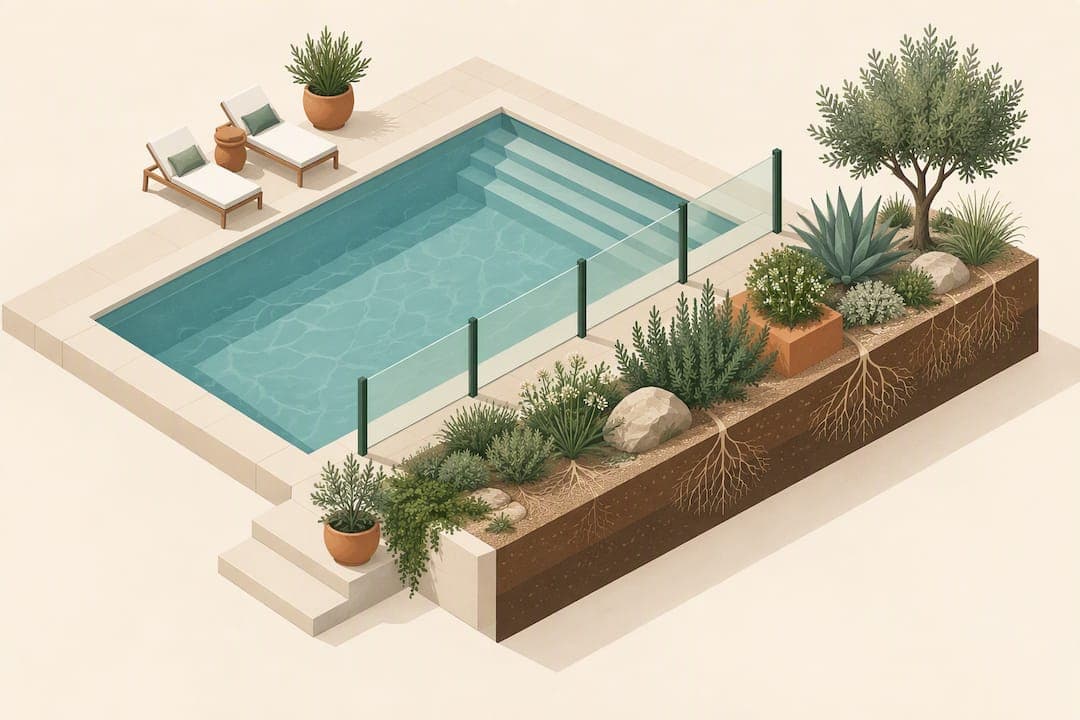
Good pool landscaping blends the right plants, privacy screens, hardscape, lighting, and clear circulation so the space looks finished and still functions well. Below you will find a dozen or so high-impact ideas with how-to notes, plus a planning checklist grounded in UF/IFAS plant-spacing rules, University of Arizona irrigation guidance, and CPSC pool-barrier recommendations.
TL;DR:
- Set mature tree clearances at 10 feet for small trees, 20 for medium, and 30 for large; palms can sit closer.
- CPSC guidance calls for a separate barrier at least 48 inches high, with self closing, self latching gates and openings under four inches.
- Choose low litter plants, place shedding varieties downwind, use drip irrigation away from decking and equipment, and keep skimmers and access panels clear.
- Grade the site before selecting materials so water drains away from the pool shell and equipment, and choose slip resistant surfaces for barefoot routes.
- Place hedges and screens behind the supervision line, keep water visible from the house or seating, and leave gate swings and equipment access unobstructed.
Table of Contents
- 1. Fresh ideas for a resort-style poolscape
- 2. Choosing plants for pools: mature size, litter, and roots
- 3. Best hardscape choices around pools and drainage basics
- 4. Privacy solutions that preserve sightlines and safety
- 5. Design approaches for narrow yards or small pools
- 6. Layered lighting, shade, and focal features
- 7. Short maintenance rules to keep the design working
- 8. A compact checklist before you start planting
- Practical creativity: beauty that lives well
- Try a 3D tool before you commit to a design
- FAQ
- Sources
1. Fresh ideas for a resort-style poolscape
Start with the moves that change a plain pool deck into a space people actually want to sit in.
- Go big with planters. Oversized pots let you add structure and color without disturbing paving or irrigation lines, and you can rearrange them as the season changes.
- Layer your plantings. Mixing low groundcover, mid-height shrubs, and a few taller accents creates the layered look common in resort-style poolscapes.
- Grow hedges for privacy, not enclosure. Keep a sightline from the house to the water so anyone inside can still see the pool.
- Add ornamental grasses and sculptural plants. Species like agave or feather grass can add texture; their upkeep depends on the site and growing conditions.
- Try a modern desert palette. Succulents, agaves, and gravel beds pair well with clean-lined, contemporary pools.
- Use natural stone pavers, or stone paired with grass joints. This look offers a different visual style from loose gravel, as shown in Martha Stewart's pool landscaping roundup.
- Install timber decking near lounging areas. Wood brings warmth underfoot where people sit or walk barefoot most often.
- Consider artificial turf for play zones. It may be an option for play zones where reducing mud is a priority.
- Add a pergola or cabana. A defined shade structure anchors the seating zone and separates it visually from the pool edge.
- Introduce one focal feature. A small fountain, a short waterfall wall, or even a modest fire bowl gives the eye somewhere to land.
- Use container accents for seasonal color. Swapping a few pots each season keeps the look current without replanting beds.
- Build in recessed seating. Built-in benches can combine seating with a planter edge in smaller yards.
- Layer your lighting. Combine path lights, step lights, and uplighting on specimen plants to extend use into the evening.
2. Choosing plants for pools: mature size, litter, and roots
Picking plants for a mature footprint, not the size they are at the nursery, prevents years of root and cleanup headaches.
- Give small trees at least 10 feet of clearance, medium trees 20 feet, and large trees 30 feet from the pool wall, a baseline from UF/IFAS tree-selection guidance.
- Palms are often the exception. Their root systems are less aggressive, so they can usually sit closer to the pool wall than broadleaf trees.
- Favor low-litter, animal-pollinated flowers where you can, and place any plant prone to shedding downwind of the water.
UF/IFAS notes that tree roots commonly extend beyond the canopy and that chlorine exposure can damage certain conifers, which is one more reason to design around a plant's full-grown spread rather than its current size.
3. Best hardscape choices around pools and drainage basics
Natural stone, pavers, timber decking, gravel, and artificial turf each come with real trade-offs. Stone, pavers, and dark concrete each have trade-offs; some finishes can become slick when wet. Timber decking can feel warm underfoot, and its maintenance needs depend on the material and conditions. Gravel may suit some drainage plans, but consider whether loose material could reach the pool. Artificial turf is one option for play zones; consider how it will feel in direct sun.
- Grade and plan drainage before you pick materials. Plan drainage so water does not collect around the pool shell or pump and filter equipment.
- Pick slip-resistant finishes for anywhere bare feet will walk near the water.
- Commit to one coherent palette. A single stone tone or paver pattern can create a coordinated look, while clean geometric lines can suit a modern design.
4. Privacy solutions that preserve sightlines and safety
Evergreen hedges, slatted timber or metal screens, trellises with low-climb vines, and tall ornamental grasses all add privacy without closing off the space.
- Keep screening behind the supervision line. You still need a clear view of the water from the house or main seating area.
- Avoid anything climbable near a barrier. A dense hedge looks like a wall, but it is not a substitute for a compliant pool fence or gate.
- Leave equipment and gate access open. Plantings should never crowd a pump pad, breaker box, or the swing path of a gate.
5. Design approaches for narrow yards or small pools
A narrow lot does not rule out a good-looking pool. Plunge pools or slim rectangular shapes paired with vertical screening keep sightlines open while using minimal width, and continuous paving along the edge preserves circulation instead of pinching it with wide planting beds.
- Use narrow planting beds and built-in benches to add greenery and seating without stealing walking space.
- Choose smaller pavers with permeable joints. They handle tight curves better and let water drain in place.
- Lean on artificial turf near entry points to cut down on soil tracked into the water.
6. Layered lighting, shade, and focal features
Low-voltage path lights, recessed step lights, and uplighting on a specimen plant or two extend the pool's usable hours without glaring into the water. For shade, a pergola, cabana, or retractable sail defines a seating zone while keeping sightlines to the pool open; fixed shade structures like those detailed on Tomellini's shade systems pages are worth a look if you want a permanent, weather-rated option. Any focal feature, whether a small fire pit, a waterfall wall, or a single specimen tree, should be scaled to the pool and placed clear of service lines.
- Dim or angle lights away from the water surface to avoid glare for swimmers.
- Size shade structures to the seating zone, not the whole deck.
- Keep focal features out of equipment pathways.
Pro Tip: Mock up lighting placement at dusk with a few portable fixtures before you commit to permanent wiring.
7. Short maintenance rules to keep the design working
- Prune palms and remove spent seed heads, and schedule a seasonal leaf clearing pass rather than cleaning year-round.
- Place litter-prone plants downwind of the pool so debris blows away from the water instead of into it.
- Switch to drip irrigation and keep spray away from decking and equipment, since excess moisture can damage both over time.
- Keep skimmers and access panels clear of plant growth and mulch at all times.
- Pick materials suited to your climate, and budget for routine upkeep like sealing stone or patching timber.
8. A compact checklist before you start planting
Before choosing a single plant or paver, map the pool shape, sightlines from the house, gate locations, barrier placement, equipment pads, drainage routes, and utility lines.
- Follow CPSC barrier guidance, which recommends a barrier at least 48 inches high on the interior side, with self-closing, self-latching gates and openings too small for a 4-inch sphere to pass through.
- Treat the barrier as its own layer. Decorative hedges and screens come after the safety barrier, never instead of it.
- Apply UF/IFAS setback distances for mature trees and University of Arizona guidance on keeping heavy irrigation away from decking and equipment.
Practical creativity: beauty that lives well
The poolside spaces that age well are the ones where sightlines, supervision, and equipment access got decided before anyone picked a single plant. Style is easy to adjust later; a tree planted too close to the shell or a hedge that blocks the gate is not. Sketching the layout, even roughly, or testing a few arrangements in a free 3D mockup before buying anything, catches those mistakes while they still cost nothing to fix.
— Rokas
Try a 3D tool before you commit to a design
Once you have a shortlist of ideas from this piece, we offer a way to see how they actually fit your yard. Our browser-based 3D planning tool links garden objects to live, itemized prices, so design changes update associated costs and quantities automatically instead of leaving you to re-measure by hand.
- Mock up your layout for free on our Free plan, no card required.
- Export a shopping list once your design is set, ready to use as you build.
- Upgrade to Home or Pro when you need more projects or advanced features; see current pricing on our pricing page.
FAQ
How far should trees be planted from a pool?
UF/IFAS guidance recommends at least 10 feet for small trees, 20 feet for medium trees, and 30 feet for large trees measured from the pool wall. Palms are typically an exception since their roots are less aggressive and can often be planted closer.
What is the minimum height for a pool safety barrier?
CPSC guidance recommends a barrier of at least 48 inches high measured on the interior side, with self-closing, self-latching gates. A barrier supplements supervision rather than replacing it.
What plants cause the least mess around a pool?
Low-litter, animal-pollinated flowering plants tend to drop less debris into the water than heavy seed- or fruit-bearing species. University of Arizona guidance also suggests placing any plant that does shed downwind of the pool to limit cleanup.
Can a hedge replace a pool fence?
No. A dense hedge adds privacy and can look like an enclosure, but it does not meet the gate-latching and height requirements laid out in CPSC pool barrier guidance. Keep a compliant barrier as a separate layer from decorative screening.
What hardscape material works best for a pool deck?
Natural stone, pavers, plain concrete, and timber decking each have different surface and maintenance characteristics; compare options for your climate and intended use. The right choice depends on your climate, budget, and how much maintenance you want to take on.
Sources
- Gardeningsolutions
- az1058
- Safety Barrier Guidelines for Residential Pools
- 20 Beautiful Pool Landscaping Ideas for Creating a Relaxing Oasis
- 30 Pool Landscaping Ideas for a Luxurious Outdoor Retreat