
A single tree installation typically runs $150 to $2,000, a shrub planting falls between $50 and $200, perennials cost $10 to $40 per pot, and lawn work spans roughly $0.10 per square foot for seed to several dollars per square foot for sod. Site access and plant size swing these numbers fast, and once a job involves grading, large-caliper trees, or tight access, hiring a pro usually costs less than the mistakes of doing it yourself.
TL;DR:
- For 1,000 square feet, seeding costs $100 to $400 and sod costs $1,000 to $3,000; sod roots in 10 to 14 days.
- A 2 to 3 inch caliper tree costs $400 to $1,000 or more installed; slopes, narrow gates, and long carry distances raise costs.
- Add a 10% to 25% contingency, because grading, poor drainage, soil amendments, irrigation, and delivery may appear as separate costs.
- DIY suits a few shrubs or perennials with easy access; hire professionals for large trees or grading, and compare itemized quotes covering identical work.
Table of Contents
- Cost-at-a-glance: per-item ranges and three example project totals
- Tree planting costs: stock types, installation, and itemized budgets
- Plant pricing 101: how size and type affect price and establishment
- Lawn seeding vs sod: per-square-foot costs, prep, and establishment timeline
- Primary cost drivers that change quotes (site, season, soil, labor)
- DIY vs hiring a pro: when each option makes sense and a contractor checklist
- Turn ranges into a budget with a 3D cost estimator (Veete example)
- Author perspective: three simple budgeting habits that save money and stress
- How Veete helps you plan and price planting projects
- FAQ
- Sources
Cost-at-a-glance: per-item ranges and three example project totals
These ranges assume a baseline accessible suburban site with no heavy excavation, no slope, and standard soil:
- Small tree (under 6 feet): $50 to $150; medium (6 to 12 feet): $150 to $500; large (over 12 feet or 2 to 3 inch caliper): $400 to $1,000 or more.
- Shrubs: $20 to $150 depending on container size and species.
- Perennials: $10 to $40 per pot, with 1-gallon pots on the lower end.
- Mulch: $30 to $60 per cubic yard installed.
- Sod: $1 to several dollars per square foot; seed: pennies to around $0.50 per square foot.
A single-tree install (medium size) might total $300 to $600. A 100-square-foot bed refresh with shrubs, perennials, and mulch often runs $400 to $900. A 1,000-square-foot lawn costs roughly $100 to $400 seeded versus $1,000 to $3,000 sodded, materials and labor combined.
Tree planting costs: stock types, installation, and itemized budgets
Nursery stock comes in three forms, and each carries a different price tag. Container trees are the most common and easiest to handle. Balled-and-burlapped (B&B) trees cost more because of their weight and the equipment needed to move them, while bare-root trees are the cheapest option but require careful handling and spring planting timing, according to Connecticut DEEP's planting guidance.
A realistic mid-range installed budget for a 2 to 3 inch caliper tree often lands between $400 and $1,000 or more, depending on region and project scope. That figure typically breaks into several line items:
- Tree stock itself, varying by species and size.
- Labor for digging, placement, and backfill.
- Delivery and equipment rental for larger specimens.
- Soil amendments, stakes, and mulch.
- Permits, where required by local ordinance.
- Warranty or follow-up care visits.
Site difficulty multiplies these costs quickly. A steep slope, a narrow gate, or a long carry distance from the truck to the planting hole adds labor hours and sometimes requires specialized equipment, pushing a quote well past the baseline range. Larger trees compound this because heavier root balls need more people or machinery to move safely.
Plant pricing 101: how size and type affect price and establishment
Garden center price tags only tell part of the story. A 1-gallon shrub might cost $8 to $15, a 3-gallon version $20 to $40, and a 5-gallon specimen $40 to $80, but installation labor often scales with size too since larger root balls take longer to place and backfill correctly.

Balled-and-burlapped and bare-root stock add their own handling considerations. B&B material needs careful transport to avoid cracking the root ball, which often means professional delivery. Bare-root stock is lightweight and cheap to ship but has a narrow planting window, usually early spring before buds break.
A few practical moves reduce installed cost without raising failure risk:
- Plant in the correct season for your region rather than paying premium off-season nursery prices.
- Choose native species suited to local soil and rainfall, which often need less amendment and aftercare.
- Buy smaller stock for mass plantings since smaller plants establish faster and cost less per unit, even though they take longer to reach mature size.
Lawn seeding vs sod: per-square-foot costs, prep, and establishment timeline
Seeding and sod serve different budgets and timelines. Seeding typically costs less per square foot than sod, with most homeowner projects landing in the $0.10 to $0.50 per square foot range for materials and basic labor. Sod costs considerably more per square foot but delivers an instant lawn instead of weeks of bare soil.
Before either option goes in, site prep adds its own costs:
- Grading and topsoil delivery if the existing grade is uneven or compacted.
- Irrigation hookup or temporary watering setup for the establishment period.
- Soil amendments like compost or lime based on a soil test.
- Post-install fertilization and the first few mowings.
Seeded lawns need 4 to 6 weeks of consistent watering before they tolerate foot traffic, while sod roots in about 10 to 14 days but still needs daily watering during that window. Either way, budget for higher water bills and possibly a rental sprinkler system through the first growing season.
Primary cost drivers that change quotes (site, season, soil, labor)
Quotes rarely match final invoices when site conditions get overlooked upfront. Access matters more than most homeowners expect: a narrow side gate, a long wheelbarrow run, or a lack of truck access near the planting area adds labor time that a phone estimate never captures.
Soil and drainage issues are the next biggest factor. Heavy clay or rocky ground often needs amendment or partial excavation, and poor drainage sometimes requires a French drain or raised bed before planting makes sense at all.
- Seasonality affects plant availability and price, with spring demand often pushing nursery prices higher.
- Delivery distance from the nursery adds fuel and time charges for larger orders.
- Local labor rates vary widely by region and season.
- Permits for tree removal or large plantings add fees and timeline delays.
- Irrigation add-ons, like running a new zone to a planting bed, are often quoted separately.
Pro Tip: Build a contingency of 10 to 25% into any planting budget to cover site surprises that only show up once digging starts.
DIY vs hiring a pro: when each option makes sense and a contractor checklist
Small plantings with easy access and minimal equipment needs, like a few shrubs or perennials, are reasonable DIY projects. Large trees, extensive grading, or anything requiring heavy equipment usually costs less in the long run with a professional crew, since equipment rental and injury risk add up fast for a one-time job.
When comparing contractor quotes, check the same items each time:
- Confirm insurance and ask for proof of liability coverage.
- Request references from recent, similar-sized projects.
- Clarify what warranty covers and for how long.
- Get a line-item quote that lists plant sizes, stock type, and labor separately.
- Confirm the timeline and who handles cleanup.
Comparing quotes on identical scope, not just a bottom-line number, avoids the apples-to-oranges pricing that makes one bid look cheaper when it actually covers less work.
Turn ranges into a budget with a 3D cost estimator (Veete example)
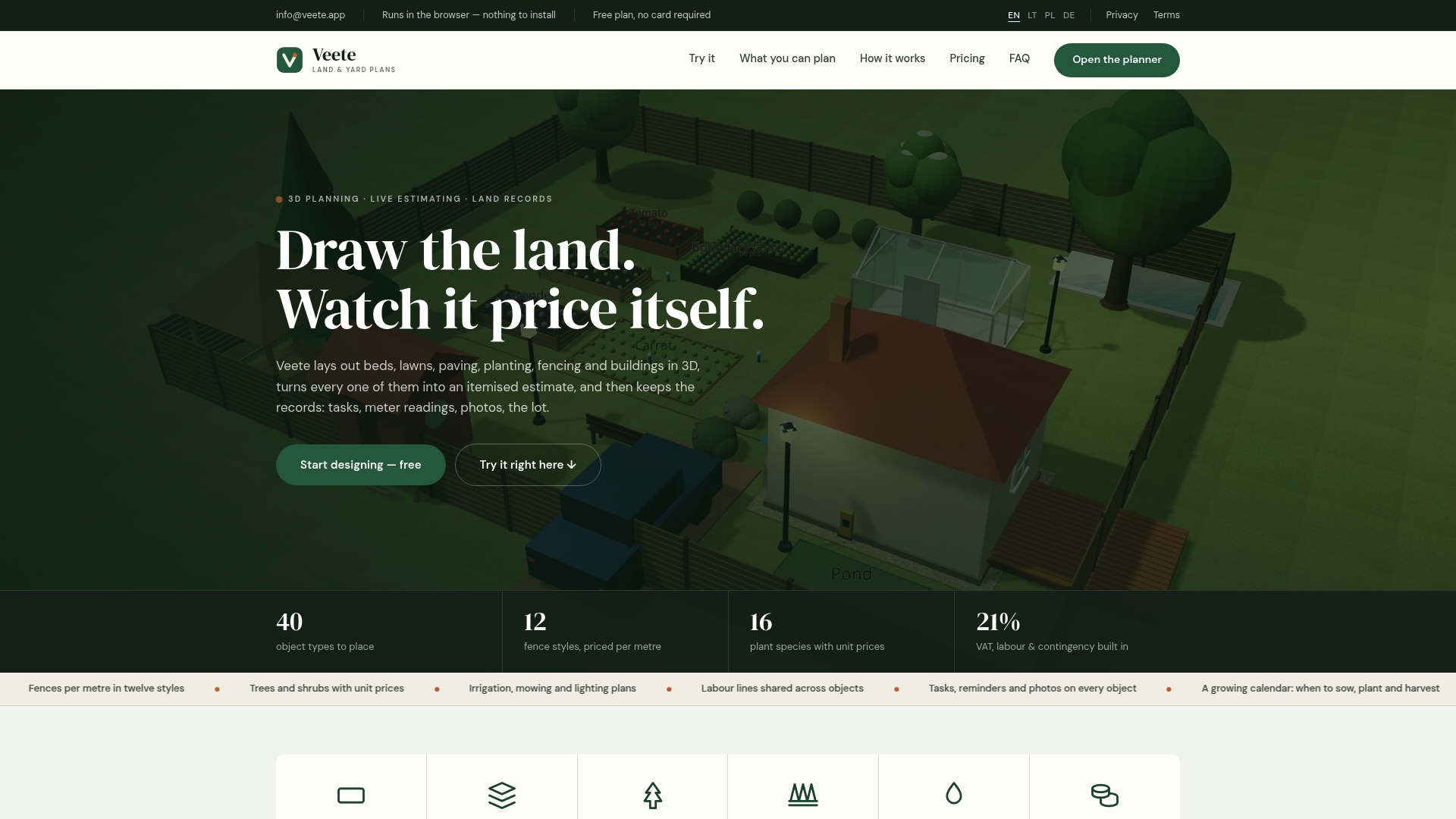
Cost ranges are a starting point, but a real budget needs object-level pricing tied to an actual layout. A 3D planning tool like Veete models beds, lawns, and trees at scale, then attaches live pricing to each object so a quantity takeoff updates automatically when a design changes.
That kind of modeling helps in a few concrete ways:
- Seeing access constraints in 3D before committing to a large-tree placement that might need special equipment.
- Testing different plant sizes against the same budget line to compare total cost instantly.
- Modeling irrigation runs alongside planting beds so water costs get planned in from the start, not added as a surprise later.
- Generating a shopping list and total estimate that reflects the actual plan, not a generic average.
This turns a rough per-square-foot range into a specific number tied to your yard's actual geometry and plant choices.
Author perspective: three simple budgeting habits that save money and stress
Measure and model your space before buying a single plant. A loose estimate always runs over once site conditions reveal themselves.
Set a contingency between 10 and 25% and treat irrigation and site prep as priorities over ornamentals; a beautiful bed on bad drainage fails within a season. For deeper planning on labor rates and mulch pricing, these details compound fast across a full yard.
— Rokas
How Veete helps you plan and price planting projects
Once you know the ranges, the harder part is turning them into a number that matches your actual yard, not a national average. We built Veete around that gap: every bed, lawn, and tree you place in your 3D plan carries its own live price, so moving a shrub or upsizing a tree updates your total instantly instead of forcing a manual recalculation.
A few things this makes easier:
- Testing a smaller tree against a larger one side by side before you commit to a budget.
- Generating an exportable shopping list and cost breakdown you can hand to a contractor or use for your own purchasing.
- Comparing seeding versus sod totals for your exact lawn footprint instead of a generic per-square-foot guess.
Our free plan requires no card and lets you model one small project start to finish. If you want multiple projects or exportable client-ready documents, our Home plan runs $48 per year and our Pro plan runs $168 per year. Start with a single bed or tree to see your real numbers before you spend a dollar on plants.
FAQ
What is the average cost to have a tree planted?
Professional tree installation typically costs $150 to $2,000, with a mid-range installed budget for a 2 to 3 inch caliper tree often landing between $400 and $1,000 or more. The final price depends heavily on tree size, site access, and whether the stock is container, B&B, or bare-root.
What did Bill Gates say about planting trees?
This question falls outside what our research for this guide covers, and we have no sourced quote to confirm or cite accurately. Focus your planning instead on the per-tree costs and establishment practices covered above.
What is the best month to plant shrubs?
Most extension guidance favors early spring or fall for shrub planting, since cooler temperatures reduce transplant stress and give roots time to establish before summer heat or winter freeze. Bare-root stock specifically needs planting in early spring before buds break, as noted in Connecticut's tree planting guidance.
What is the 70/30 rule in gardening?
This specific rule is not covered in the extension and cost sources used for this guide, and definitions vary depending on the source. If you have seen it referenced for your region, check with a local extension office for the specific guidance behind it.
How much should I budget for lawn seeding versus sod?
A 1,000-square-foot lawn typically costs $100 to $400 seeded versus $1,000 to $3,000 sodded, covering materials and basic installation labor. Sod costs more upfront but gives you a usable lawn in 10 to 14 days, while seed takes 4 to 6 weeks to establish.