
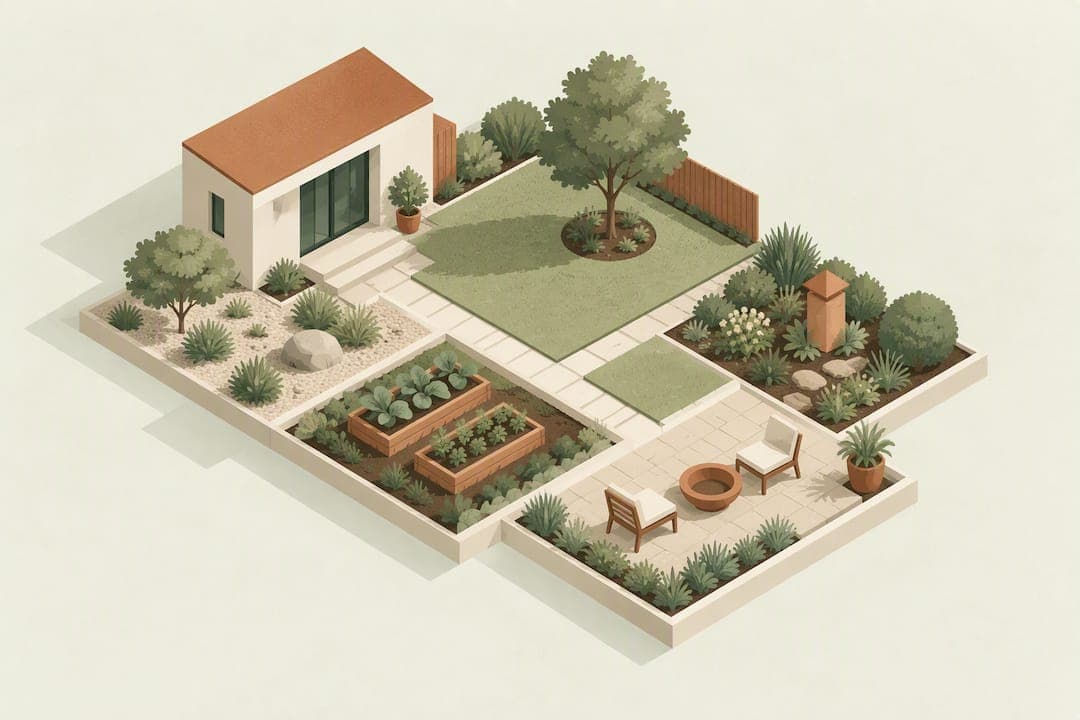
Sustainable landscape design means shaping a yard around its own sun, soil, and water patterns instead of fighting them, so it needs less irrigation, fewer chemicals, and less of your weekend. The payoff is concrete: lower water bills, healthier soil, more pollinators and birds, and a yard that holds up through dry spells. Getting there starts with three ideas: right plant in the right place, working soil, and smart water management.
TL;DR:
- Map sun, drainage, reflected heat, and use zones before planting; a seasonal site sketch guides species, rain garden placement, and irrigation needs.
- Montgomery County guidance calls for rain gardens to contain at least 75% native plants, with ponding depth and soil percolation tested for proper sizing.
- Plan for supplemental watering during the first one to two years; smaller, staged plantings generally establish more successfully than large plants installed all at once.
- Keep 2 to 3 inches of organic mulch on beds, and use timed drip irrigation to reduce evaporation and limit supplemental watering after establishment.
Table of Contents
- Core principles of sustainable landscape design
- Mapping your yard: sun, shade, drainage, and use zones
- Soil health and water management on site
- Planting for resilience: native species and plant communities
- Designing for biodiversity and ecosystem services
- Practical ideas you can start this season
- Establishment and maintenance in the first few years
- How a 3D planning tool turns these ideas into a buildable plan
- Why aesthetics and ecology do not have to compete
- Plan your garden with Veete before you dig
- FAQ
- Sources
Core principles of sustainable landscape design
Every sustainable yard rests on a small set of rules, and the most important one is matching plants to the site rather than forcing the site to fit the plants. The Florida-Friendly Landscaping principles call this "right plant, right place," and applying it typically removes the need for many of the irrigation, fertilizer, and pesticide inputs that traditional landscapes depend on.
From there, design decisions should serve a function, not just a look. A bed of plants can shade a window, catch runoff, and feed pollinators at the same time, so each square foot earns its place.
A few habits carry most of the weight:
- Match species to existing sun, soil type, and moisture instead of amending the ground to suit a plant you like.
- Design for a job (shade, stormwater capture, habitat) rather than a single visual theme.
- Favor diversity and layered structure over single-species plantings, which resist pests and weather swings better.
- Let natural processes, infiltration, soil biology, plant succession, do the maintenance work instead of chemicals and machines.
Mapping your yard: sun, shade, drainage, and use zones
Before anything goes in the ground, walk the property and record what it actually does across a season. Thirty minutes with a notebook or a phone camera saves months of replanting.
- Watch where water goes during and after rain: note low spots, puddling, and where downspouts discharge.
- Track sun exposure at a few points through the day to spot full sun, part shade, and deep shade zones.
- Notice microclimates such as reflected heat off walls or paving, and wind corridors along fence lines or gaps between buildings.
- Separate the yard into hard-use zones (paths, play areas, seating) and planting or wild zones, and set a maintenance level for each.
- Sketch rough measurements on paper, or photograph each zone and import the images into a planning tool to build a to-scale layout.
That sketch becomes the base layer for every later decision, from where a rain garden can sit to which beds get drought-tolerant plants and which can handle regular irrigation.
Soil health and water management on site
Healthy soil holds water, feeds plants without added fertilizer, and reduces runoff before it ever reaches the street. Building it starts with compost, worked in lightly rather than tilled deep, and avoiding compaction from foot traffic or heavy equipment on wet ground.
Managing stormwater on site is the next lever. Montgomery County's RainScapes manual explains how rain gardens and bioswales intercept runoff from roofs and pavement and let it soak in rather than run off, and the county's guidance requires rain gardens to use at least 75% native plants for long-term resilience, with specific ponding depth and percolation test criteria for proper sizing. A detailed walkthrough of siting and sizing one is in our rain garden design guide.
A few more habits round out the water strategy:
- Keep 2 to 3 inches of organic mulch on beds to slow evaporation, suppress weeds, and feed soil biology as it breaks down.
- Disconnect downspouts where possible and route them toward planted areas instead of pavement.
- Install drip irrigation on timers rather than overhead spray, which loses more water to evaporation and wind drift.
- Limit supplemental watering to the establishment period once plants are settled into the right spot.
Planting for resilience: native species and plant communities
Native plants earn their reputation because their root systems evolved for local rainfall and soil, not because they are the only option that works. Iowa DNR's native landscaping guidance notes that deep-rooted native prairie species build soil organic matter and improve water retention over time, which is why established native beds often need little to no irrigation.

The stronger move is designing in communities rather than single species: a canopy tree, an understory layer, shrubs, and groundcovers that each fill a niche and shade out weeds. A useful bed layout for this kind of layering is covered in our 4-foot garden bed guide.
A short checklist for plant selection:
- Group plants by shared sun and moisture needs so watering and mulching stay simple.
- Choose a mix of bloom times for season-long pollinator support rather than one big spring show.
- Avoid monocultures: a single species planted in mass is more vulnerable to pests and disease.
- Leave structural variety, taller plants at the back or center, lower ones at the edges, for both looks and wildlife cover.
Designing for biodiversity and ecosystem services
A yard built this way does more than look good: it cools nearby surfaces, filters rainwater, and gives wildlife somewhere to live. The ASLA biodiversity primer frames this as an adaptive, regenerative approach, restoring soil function and designing for heterogeneity rather than a fixed, finished look.
In practice that means stacking functions in the same space: a rain garden that also feeds pollinators, a shade tree that also hosts birds, mulch that also builds carbon in the soil. It also means checking in over time and adjusting species, mulch depth, or irrigation as conditions change rather than treating the first planting as final. Where neighbors are doing similar work, connecting plantings across property lines multiplies the habitat value for everyone involved.

Practical ideas you can start this season
A handful of changes deliver most of the benefit without a full yard overhaul.
- Place deciduous trees on the south and west sides of the house for summer shade and winter sun, a technique the U.S. Department of Energy's landscaping guidance ties to measurable reductions in heating and cooling demand.
- Replace a section of lawn with a native meadow mix or groundcover to cut mowing and watering, using a low-maintenance template like the one in our low maintenance landscaping guide.
- Swap solid concrete for permeable pavers, gravel strips, or a vegetated swale along high-runoff paths, detailed further in our garden path design guide.
- Add a rain barrel under a downspout and pair it with drip irrigation so stored water goes straight to beds that need it.
None of these require tearing out the whole yard at once. Each one works as a standalone project that still moves the whole property toward lower input use.
Establishment and maintenance in the first few years
The first one to two years decide whether a planting thrives or struggles. Extension guidance from the University of Arizona stresses that new plantings typically need supplemental water through this establishment window, and warns against installing large containerized plants without a reliable water source lined up first. Smaller plants, staged over a season, generally survive better than a handful of big ones dropped in all at once.
A few habits carry a planting through that window:
- Water deeply but less often to encourage roots to grow downward instead of staying shallow.
- Keep organic mulch at 2 to 3 inches; avoid gravel or other inorganic mulch where it can disturb soil and favor weeds.
- Check plantings seasonally for pests, but expect some visible insect activity as a normal sign of a functioning system rather than a problem to spray away.
- Adjust watering and mulch as the seasons shift: more attention in summer heat, less once fall rains arrive.
Pro Tip: Stagger planting over two seasons instead of all at once, it spreads out watering demands and lets you learn what the site needs before committing the whole budget.
How a 3D planning tool turns these ideas into a buildable plan
Mapping sun angles, slope, and downspout paths on paper works, but seeing them in a to-scale model makes it easier to size a rain garden correctly or decide exactly where a shade tree should go. A 3D layout tool lets you drop in beds, lawn, and paving, then adjust sun and drainage notes as you refine the plan.
The practical gain is in the numbers behind the design: an itemized, adjustable cost estimate for materials and plants, a shopping list that updates as the layout changes, and an exportable plan to hand a contractor once the design is set, with task tracking through the establishment phase that follows.
Why aesthetics and ecology do not have to compete
The biggest misconception about sustainable yards is that they have to look wild or unfinished. Good design proves otherwise: structure, repetition, and seasonal color carry the eye just as well with native species as with ornamentals, and the RHS notes that texture and seasonal change are part of what makes a garden rewarding to live in day to day.
My honest advice: do not redesign the whole yard at once. Convert one bed, watch how it performs through a full year, then expand. Small, observed changes beat a big plan that nobody maintains.
— Rokas
Plan your garden with Veete before you dig
Turning a sketch into a working plan gets easier with a 3D view of beds, lawn, and paving that updates its cost estimate as you move things around. We built Veete so you can lay out a rain garden, a shade tree, or a lawn-to-meadow conversion and see the materials list and price change in real time, rather than guessing at quantities after the fact.
Our free plan needs no card to start, and the Home and Pro plans add exportable documents for contractor handover plus multi-project tracking as your yard grows season by season.
FAQ
What is sustainable landscape design?
Sustainable landscape design shapes a yard around its existing sun, soil, and water conditions so it needs less irrigation, fewer chemicals, and less ongoing maintenance. The core method is matching plants to the site, a principle the Florida-Friendly Landscaping guide calls "right plant, right place."
What are the 5 basic elements of landscape design?
Most landscape design frameworks point to line, form, texture, color, and scale as the visual building blocks, though sustainable design adds function (water, habitat, shade) as an equally important layer on top of those elements. Definitions vary somewhat between design schools, so treat this as a general guide rather than a fixed standard.
What are examples of sustainable design in a yard?
Common examples include rain gardens that capture roof runoff, native plant beds that need little supplemental watering once established, permeable paving that lets water soak in instead of running off, and strategically placed shade trees that cut cooling costs, an approach the Department of Energy links to lower heating and cooling demand.
What is biophilic landscape design?
Biophilic landscape design focuses on the sensory and psychological benefits of green space, things like texture, seasonal change, water sound, and visible wildlife, that make a garden feel good to spend time in, a connection the RHS ties to well-being. It overlaps with sustainable design but centers on human experience rather than resource inputs alone.
How long does it take for a sustainable yard to become low maintenance?
Most new plantings need regular supplemental watering for about one to two years while roots establish, according to University of Arizona extension guidance. After that establishment period, a well-matched planting typically needs far less water and weeding than a conventional lawn or bed.
Sources
- Florida-Friendly Landscaping: 9 Principles
- RainScapes stormwater garden project manual — Montgomery County DEP
- Biodiversity primer for landscape architects — ASLA (2025)