
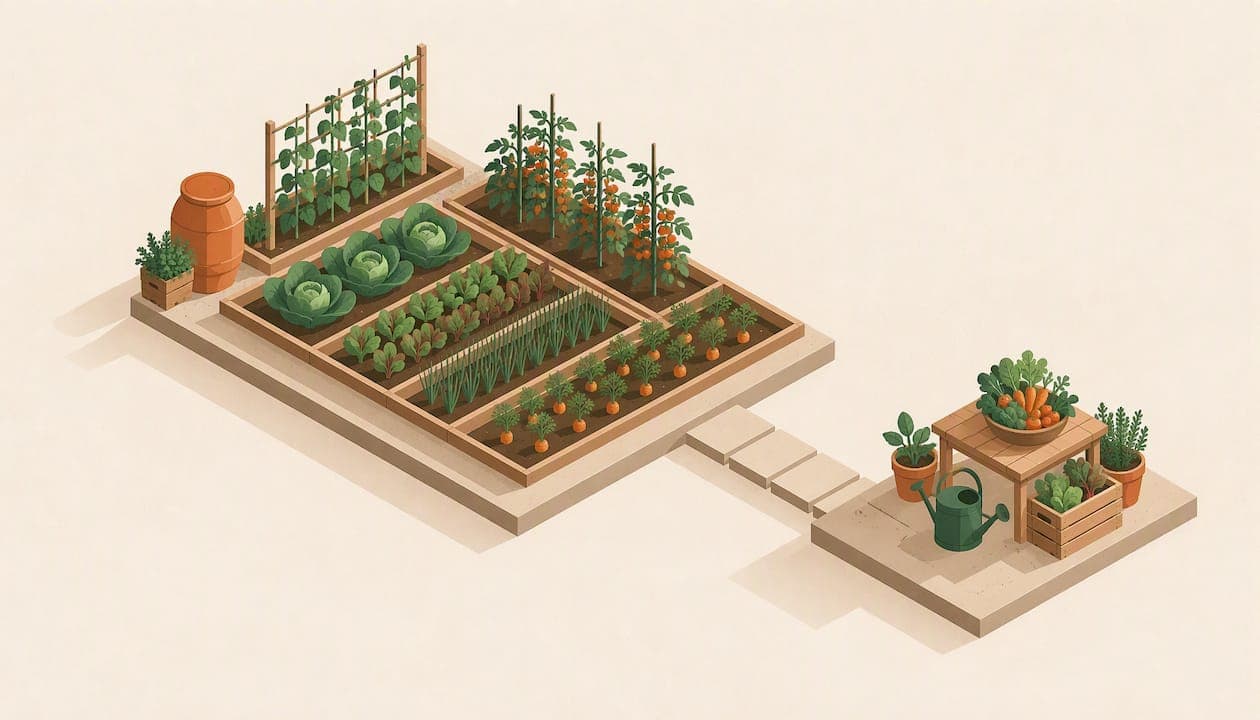
A good edible garden plan answers five questions before you buy a single seed: where the sun falls, how much space you can actually look after, what you want to eat, how beds will be laid out and rotated, and what it will all cost. Get those right on paper and the planting season gets much easier. This guide walks through each one, for a vegetable plot, a raised-bed setup or a full edible landscape.
TL;DR
- Pick the site first: at least 6 to 8 hours of direct sun, water nearby, level and well-drained ground.
- Start smaller than you think. A 25 to 50 square foot starter garden is easier to keep up than a big plot you abandon by July.
- Group crops by plant family from day one, so crop rotation is a matter of moving a block of beds, not redrawing the garden.
- Price the plan before you build: frames, soil, fencing and paths often cost more than the plants.
- Keep the plan as a living document, with beds, quantities and costs tied together, so one change updates the rest.
Table of Contents
- Start with the site, not the seed catalog
- Decide how big the garden should be
- Choose what to grow
- Lay out beds you can actually reach
- Plan crop rotation from the start
- Budget the whole garden, not just the plants
- Edible landscaping: food in the front yard too
- Our perspective
- Plan and price your garden in 3D
- A step-by-step process to finish this winter
- FAQ
- Sources
Start with the site, not the seed catalog
Every extension service we read agrees on this point: location matters more than anything else. Virginia Cooperative Extension lists the core requirements: at least 6 to 8 hours of direct sun a day, an accessible water source, level ground to limit erosion, and fertile, well-draining soil. Avoid low spots where cold air settles, and keep beds far enough from trees and shrubs that they do not compete for light, water and nutrients. Rutgers makes the same point about drainage: no standing water, even after the heaviest rain.
A practical way to check your site:
- Walk the yard at 9 a.m., noon and 3 p.m. and note which areas are in full sun. Do it again in the season you plan to grow, because shade patterns shift.
- Locate the nearest hose bib. If you have to drag a hose across the lawn, you will water less.
- Choose a spot you pass every day. A bed visible from the kitchen window gets weeded and harvested.
- Look for low spots and wet patches after rain.
- Check the history of the area. Virginia Tech recommends soil lead testing if there has ever been a structure or painted surface there. If a painted fence or old outbuilding stood nearby, a guide to lead-safe prep around painted wood is a useful read before you dig.
If the site needs clearing first, for instance brush, stumps or overgrown fence lines, sort that out before you design anything. This land preparation guide covers what clearing involves for a property.
Our backyard landscape planning guide covers the broader first steps for the whole yard, which helps if the vegetable garden is only one part of a larger project.
Decide how big the garden should be
The most common beginner mistake is overestimating how much you can manage. The Connecticut Agricultural Experiment Station says garden size should reflect your family, the crops you want, your physical ability and your available time. Plan for the hours to maintain the garden, not just to plant it.
The University of Maryland Extension suggests a starter garden of 25 to 50 square feet, and you can always expand later. That is roughly one 4x8 bed plus a container or two.
Small does not mean unproductive. A Kentucky extension guide says a well-planned garden can yield 600 to 700 pounds of produce per 1,000 square feet, using intensive methods such as succession planting (replacing harvested crops with new ones) and intercropping (fast radishes between slower squash, for example).
Choose what to grow
Write two lists: what your household eats most, and what is expensive or poor in stores. Herbs, salad greens, tomatoes and peppers often win on both. Then check each crop against your sun and space:
- Tall and climbing crops (pole beans, cucumbers on a trellis) go on the north side so they do not shade shorter plants.
- Quick crops (radishes, lettuce, spinach) fill gaps while slow crops get established.
- Perennials (asparagus, rhubarb, berries, fruit trees) get their own permanent zone, not a spot in the rotation.
- Herbs you use daily go closest to the kitchen door.
Timing matters too. The University of Wisconsin advises finishing your garden plan by early February so there is time to order seeds and start transplants. Your local last-frost date, available from your state extension office, sets the calendar for your region.
Lay out beds you can actually reach
Bed width decides how easy the garden is to work. If you can reach the middle from either side, you never step on the soil, and you can plan neat blocks. Our 4x8 raised bed layout templates and the 4-foot bed layout guide show how to arrange beds, spacing and access so nothing is out of reach.
A few layout rules that hold up in practice:
- Leave paths wide enough for a wheelbarrow. Our garden path design guide gives widths and depths with costs.
- Orient beds so rows run north to south where possible, giving even light.
- Put water, compost and tools near the center of the garden, not at the far end.
- Mark the permanent features (perennials, trellises, fence) first, then fit the annual beds around them.
Raised beds or in-ground?
Raised beds warm earlier, drain well and keep you off compacted soil. They also cost more up front. The Alabama Cooperative Extension raised bed guide reports spring 2024 retail data showing a 4x4x12 inch bed costing roughly $60 to several hundred dollars, depending on frame and soil quality. For a 4x8x12 inch bed (32 cubic feet), bulk soil media typically ran $34 to $71, while the same volume in bags reached $213 to $278.
The same guide notes that raised bed soils drain excessively in their first year. As organic matter breaks down into humus, water retention improves, so expect to water more often in year one than in later years.
Plan crop rotation from the start
Rotation is the part of vegetable bed planning that most people leave until the second year, when it becomes a puzzle. Build it in now.
The rule, from the Alabama Cooperative Extension, is to avoid planting anything from the same family in the same spot two years in a row. Potatoes, eggplants and tomatoes are all nightshades, so potatoes should not follow eggplants. The same page has a plant family table you can use as a reference.
A simple rotation schedule
Group your crops into four blocks by family, and give each block its own bed or set of beds:
| Block | Typical crops | Family |
|---|---|---|
| A | Tomatoes, peppers, eggplant, potatoes | Nightshades |
| B | Cabbage, broccoli, kale, radishes | Brassicas |
| C | Beans, peas | Legumes |
| D | Onions, garlic, carrots, lettuce | Alliums, carrots, composites |
Each year, shift every block one bed along. After four years every block has visited every bed. Cucumbers, squash and melons are another family, so either add a fifth block or share a bed with one of the others and track it carefully. Treat this as a starting framework, not a rule from a single source: your local extension office can tell you which pests and diseases in your region make longer gaps worthwhile.
Rotation in raised beds
Raised beds are easy to rotate when each bed is dedicated to one block. With four 4x8 beds, you move the plan, not the soil. With only one or two beds, rotate within the bed by splitting it into sections, and add a compost layer between seasons. Keep a record of what grew where, since a plan you cannot look up in three years is no plan at all.
Budget the whole garden, not just the plants
Seeds are cheap. Structure and soil are not. Typical cost lines for a home edible garden:
- Bed frames or edging
- Soil and compost, by the cubic foot or yard
- Irrigation: hose, drip line, timers
- Fencing or localized protection
- Paths and mulch
- Trellises and supports
- Seeds, transplants, fertilizer and amendments
Some costs spread out over time. A Utah State University budget assumptions document treats a 50 lb bag of fertilizer as a long-term asset that gets divided among several garden sections and purchased only every three years. It also spreads garlic seed cost over 10 years to account for disease losses. Thinking this way keeps your first-year number honest without making the garden look unaffordable.
Fencing deserves a hard look. The University of Wisconsin guide notes that a fence keeps out rabbits but takes up space, harbors weeds and insects along the line, and complicates soil prep with power equipment. Consider localized protection for sensitive crops before committing to a full perimeter.
For estimates by item, see our planting cost guide and the landscape material list guide, which explains how to work out mulch and soil quantities without guessing.
Edible landscaping: food in the front yard too
If you want food and beauty from the same space, an edible landscape mixes fruiting shrubs, perennial herbs, ornamental vegetables and flowers. NC State Extension offers three example designs for the same quarter-acre suburban plot, with raised beds, windbreaks and an arbor. It also says you do not have to go all in: you can start by replacing a few ornamentals with edibles.
A workable approach is to layer the planting: trees at the back or corners, shrubs and berries in the middle, herbs and annuals at the edges. Keep high-maintenance crops, such as tomatoes and cucumbers, in beds where you will see them often, and let perennials carry the front.

Our perspective
Most garden plans fail on numbers, not on design. People draw a lovely layout, then discover that the soil for twelve beds costs more than the budget, or that moving one bed means recalculating everything by hand. That is the problem we built Veete to solve: every object in the plan carries its own price, so when you resize a bed, add a path or swap a frame material, quantities and costs move with it.
Our advice for edible gardens is simple. Draw the permanent structures first. Group annual crops by family so rotation is built in. Enter your own supplier prices instead of generic ones. And keep the plan after planting, because next year's rotation depends on what grew where this year.
— Rokas
Plan and price your garden in 3D
Veete is a browser-based 3D planner for beds, lawns, paving, planting, fencing and structures, with live cost estimates that follow every change. You can add your own supplier rates, build shopping lists, export plans and keep task and land records. There is a free plan with no card required, plus Home at €48 per year or €6 per month, and Pro at €168 per year or €19 per month. See the plans and pricing or start on the Veete site.
A step-by-step process to finish this winter
- Walk the site and note sun, water, slope and soil history.
- Set a size you can maintain, starting from 25 to 50 square feet if you are new.
- List crops by what you eat and what suits your space.
- Group them by family into rotation blocks.
- Draw permanent features (beds, paths, trellises, fencing) to scale.
- Price everything, including soil, frames and irrigation.
- Set the calendar from your last-frost date, finishing the plan in time to order seeds.
- Record what you plant where, so next year's rotation is a lookup, not a guess.
FAQ
How do I plan a vegetable garden for the first time?
Start with a sunny, level, well-drained spot that gets 6 to 8 hours of direct sun. Keep it to a manageable size, such as 25 to 50 square feet, and choose crops your household really eats. Sketch the beds on paper or in a planner, then add a crop list and a budget.
How often should I rotate crops?
Avoid planting the same plant family in the same spot two years in a row, according to the Alabama Cooperative Extension. Many gardeners go further and use a multi-year cycle with four blocks of crop families. Your local extension office can advise on the cycle that suits regional pests and diseases.
Can I rotate crops in raised beds?
Yes. Give each raised bed a crop family and move the plan each year. If you have only one bed, divide it into sections and rotate within it, adding compost between seasons. Keep a simple map of each year's planting.
How much does an edible garden cost to set up?
It depends heavily on beds and soil. Alabama Extension spring 2024 data put a 4x4x12 inch raised bed at roughly $60 to several hundred dollars, and soil for a 4x8 bed at $34 to $71 in bulk. Add irrigation, fencing, paths and plants to get your total, and price them before you build.
Sources
- Virginia Cooperative Extension: Planning the Vegetable Garden
- Rutgers NJAES: Planning a Vegetable Garden
- Connecticut Agricultural Experiment Station: Planning Your Garden
- University of Maryland Extension: Planning a Vegetable Garden
- Kentucky: Home Vegetable Gardening (ID-128)
- University of Wisconsin: The Vegetable Garden (A1989)
- Alabama Cooperative Extension: Raised Bed Gardening
- Alabama Cooperative Extension: Crop Rotation
- Utah State University: Microfarm budget assumptions
- NC State Extension: Growing Edibles in the Landscape