
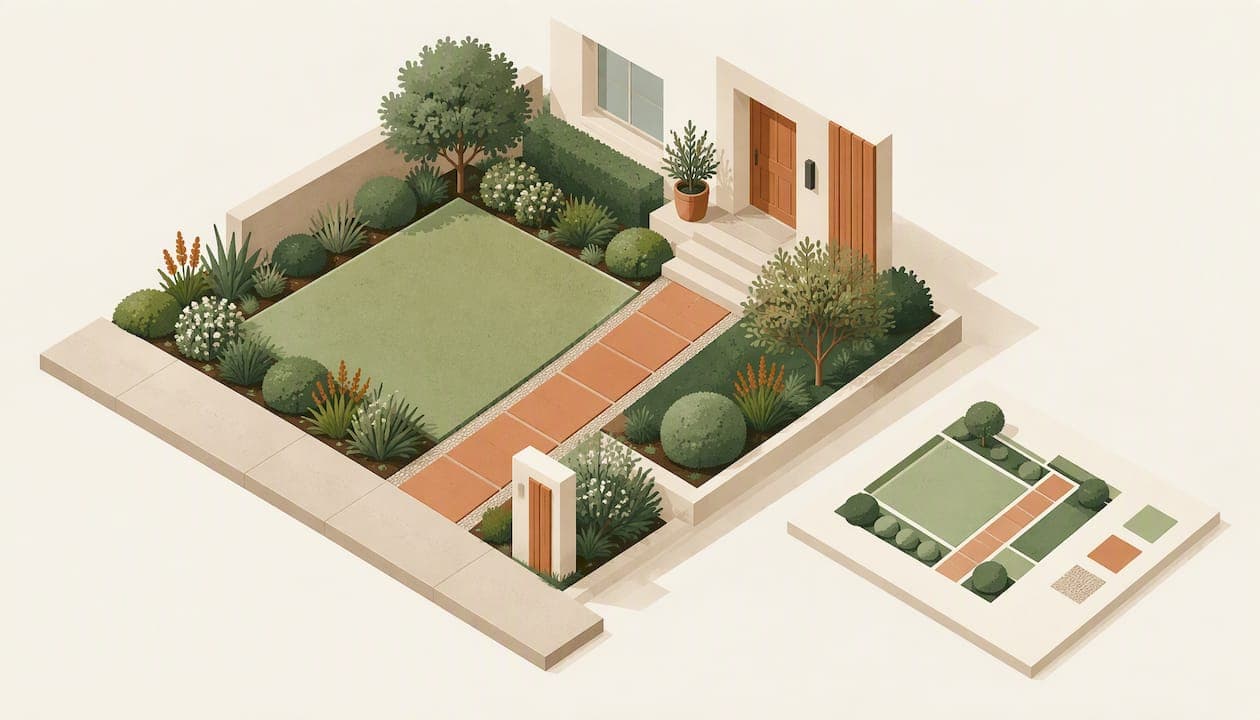
Good front yard landscaping starts with the site, not the shopping list. Measure the space, note sun, slope and drainage, decide what the yard must do (welcome guests, hold a car, handle rain), then choose plants and hard surfaces to fit. In the US, a professional front yard refresh typically runs $1,500 to $5,000, so the order you work in matters, because mistakes are expensive to dig up.
This guide walks through that order: assess, lay out, plant, price, and phase the work.
TL;DR
- Assess sun, soil, slope and drainage before you buy anything. Extension guidance calls this working with your site rather than against it.
- Lean on plants over paving. Hardscape labor often costs more than the materials, so softscape is the cheaper route to curb appeal.
- Plan for the mature size of every plant, and group plants in odd numbers (3, 5, 7) for a natural look.
- Budget by object (each bed, path, shrub, yard of mulch), so a design change updates the total instead of leaving you with a stale estimate.
- Check HOA rules and local setbacks before you commit, especially on corner lots.
Table of Contents
- Start with the site, not the style
- Drainage before design
- Lay out the yard in zones
- The design principles that do the heavy lifting
- Plants and surfaces: what to put where
- What front yard landscaping costs
- A sample plan for a typical suburban front yard
- Perspective: why we plan landscapes in 3D with live pricing
- Plan and price your front yard in Veete
- Rules to check before you dig
- FAQ
- Sources
Start with the site, not the style
Most front yards that disappoint were designed from a photo rather than from the ground they sit on. Extension designers put it simply: the first rule is to assess topography, soil drainage and light exposure before buying or moving a plant. A north-facing yard wants shade-tolerant plants. A south-facing slope with thin soil wants drought-tolerant ones. Forcing the opposite costs you in replacements and watering.
Spend a Saturday on a simple site survey:
- Measure and sketch. Property line, house footprint, driveway, walk, windows, downspouts, utility boxes, meters and existing trees. Note street-side distances too.
- Track the sun. Check the yard at 9 a.m., noon and 4 p.m. Mark full sun (6+ hours), part shade and full shade.
- Watch water. After a heavy rain, see where it pools and where it runs. Note which way the ground slopes relative to the house.
- Check the soil. Dig a few holes. Is it sandy, clay-heavy or compacted from construction?
- List what must stay. Mature trees, a good hedge, a working walkway.
If you want the drainage-first sequence in more depth, our front yard landscaping plan covers it step by step.
Drainage before design
Water is the one thing in a front yard that can damage the house. Guidance for homeowners building rain gardens or stormwater basins is to find the natural low spots and make sure water always drains away from buildings. The Phoenix green stormwater handbook recommends professional consultation if you install such features within 10 feet of your foundation, because the risks are structural damage and basement flooding.
In practice:
- Keep beds from trapping water against the foundation. Grade soil away from the house.
- Extend downspouts into a planted swale or a rain garden placed well away from the wall.
- If you are considering any basin or major regrading near the foundation, bring in a licensed landscape contractor or civil engineer first.
Lay out the yard in zones
A front yard has three jobs: arrival, display and storage (cars, bins, utilities). Think of it in zones, then draw each one.
Arrival: the path and the door
The walkway from street or driveway to the door is the spine of the design. Make it direct, wide enough for two people to walk side by side, and let it curve only if there is a reason (a tree, a slope). Lighting along it is cheap to add early and costly to retrofit.
Display: beds and borders
Beds do the visual work. A common mistake is the narrow ribbon: a thin perennial strip hugging the foundation while a vast lawn stretches to the street. Penn State Extension flags this as a scale problem, and notes that plants and hardscape should match the home's architecture. Fix it by deepening beds, wrapping them around corners and anchoring them with a small tree or a shrub mass.
A rule of thumb many designers use: make foundation beds at least as deep as the mature width of the shrubs you plant in them, so the plants do not crowd the walk or the siding.
Storage: parking, bins and utilities
Hide what you cannot move. Evergreen shrubs or a low screen cover meters and bins. For parking, a lighter-touch approach than a full slab is two paved wheel tracks with permeable fill between them. The RHS suggests two paved tracks for the wheels, with the rest covered in gravel or grass-reinforcing grids. Low, tough plants such as creeping Jenny, bugle and thyme can fill gaps if the car moves regularly. The advice comes from the UK, but the principle of keeping surfaces permeable applies to any climate where runoff is a concern.

The design principles that do the heavy lifting
You do not need a design degree. Three ideas cover most of what separates a polished yard from a patchy one.
Odd-numbered groups. The "rule of three" is a foundational principle: planting in 3, 5 or 7 gives natural-looking groups, whereas even-numbered or perfectly symmetrical groupings tend to look rigid, according to extension guidance.
Repetition. Repeating a color, shape or plant type creates rhythm along the length of the yard. The savings angle: you can often get repetition by dividing and replanting existing groundcovers and perennials rather than buying new ones.
Mature size. A plant at the nursery is a baby. Design for how it will look in five to ten years, so you avoid pulling out overcrowded shrubs shortly after installation. Penn State's guidance is to build those growth projections into the plan from the start.
If you are choosing a fence or low wall for privacy at the street edge, check local height limits and HOA rules first. A solid front fence changes the character of the whole yard and, in many neighborhoods, is restricted.
Plants and surfaces: what to put where
Lawn, less of it
A small, well-shaped lawn reads as intentional. A large, empty one reads as a maintenance chore. Reducing turf is among the most common upgrades, and it saves water and mowing time. If you keep grass and have a dog, a dog-friendly lawn seed mix is worth a look for the high-traffic strip by the walk.
Lawn pricing varies widely by method and region. Our lawn installation cost guide breaks down seed versus sod, and Angi lists sod at $0.35 to $0.85 per square foot for the material alone.
Gravel and dry gardens
A gravel front garden suits sunny, dry sites and can look sharp with the right plants. Two details from extension horticulturists prevent the usual failure. First, skip landscape fabric under gravel: Wisconsin Extension guidance says it blocks water infiltration. Second, apply gravel at a depth of 4 to 5 inches, where it works as a water-wise mulch. Plant roots grow down through it.
Be careful with gravel in an HOA. Some covenants require a minimum share of living turf in the front yard, and a compliance guide for HOA landscaping notes that this can effectively rule out gravel or artificial turf in prominent areas. Read your own documents rather than assuming.
Year-round structure
A yard that looks good in June and bare in January is half a design. Mix evergreens for winter, perennials for spring and summer, and shrubs with bark or berries for the off-season. Choose plants suited to your USDA zone and your local extension office's recommendations.
For options that keep upkeep low, see our ranked low maintenance landscaping ideas.
What front yard landscaping costs
Price ranges depend on region, yard size and how much hardscape you add. Here is how the numbers stack up from published 2026 data.
| Project scope | Typical US cost | Source |
|---|---|---|
| Professional front yard refresh | $1,500 to $5,000 | Angi |
| Full backyard renovation | $15,000 to $50,000 | Angi |
| Average professional landscaping, standard lot | $3,516 | Angi |
Why is the front yard cheaper? HomeAdvisor notes that front yard makeovers generally cost less because they rely on plants and fresh sod rather than big-ticket hardscape. Pro House Maintenance's 2026 roundup gives the same $1,500 to $5,000 range for the front.
These are national ranges. Your own figure depends on your local labor rates and your supplier's plant and stone prices, so treat them as a sanity check, not a quote.
The cheapest route
The cheapest landscaping is not a specific material but an approach: low-maintenance native plantings and softscape (soil, sod, shrubs, perennials) over hardscape (concrete, paving, stone). The University of California's guide to planning your hardscape calls hardscape permanent and relatively costly, and recommends careful planning before building. Labor often outweighs materials, and structures need heavier base preparation.
If you do want a paver walk or patio, see our guide to paver patio design so you can judge a quote before you sign.
Pricing by object, not by guess
Budgets go wrong when the plan and the spreadsheet drift apart. You widen a bed, and nobody updates the mulch quantity. You swap a path material, and the labor line stays the same. The fix is to price every object in the plan: each bed in square feet, each path in linear feet, each shrub by count, each material by unit.

For a longer look at how costs play out over a decade, read our landscape cost guide, and for plant budgets specifically see planting costs from seed to sod. If you hire out, pricing landscaping services like an estimator shows what a fair line-item quote looks like.
A sample plan for a typical suburban front yard
Take a 40-by-30-foot front yard with a single-car driveway, a straight walk, one maple and a foundation strip along the house. Here is a sequence that keeps cost under control:
- Fix water first. Redirect downspouts and regrade any slope toward the house.
- Reshape the lawn. Replace the long rectangle with a smaller curved lawn and enlarge the beds into the space.
- Build deep beds. Wrap a bed around the maple, then repeat the same grass or perennial every few feet along the foundation for rhythm.
- Plant in groups. Three shrubs of one kind near the corner, five perennials of one kind at the walk, repeated once further along.
- Mulch. Cover bare soil in the beds so weeds stay down and the soil holds moisture.
- Add hardscape last, and only if the budget allows: a wider walk, a border edge, lighting.
Phasing is a legitimate strategy. Do the drainage and structure plants in year one and add the secondary layers in year two. It spreads the spending without compromising the design.
Perspective: why we plan landscapes in 3D with live pricing
We built Veete because the same two problems kept showing up in garden projects: the drawing and the price lived in different places, and any change broke one of them. A homeowner widens a bed by two feet, and the mulch order is wrong. A contractor revises a path, and the quote is out of date by the time it is sent.
Our approach is to tie pricing directly to the objects in the plan. When you change a bed, a lawn or a fence in 3D, quantities and costs update with it, and you can enter your own supplier rates instead of generic averages. That removes manual re-measuring and keeps the estimate in step with the design.
Our advice for a front yard: draw it to scale, put the mature plant sizes in the plan, price each object, and only then decide which phase to build first. Seeing the yard in 3D also exposes scale problems, like that narrow ribbon bed, long before you dig.
— Rokas
Plan and price your front yard in Veete
Veete runs in the browser, so there is nothing to install. You can start on the Free plan with no card required, and build beds, lawns, paving, planting and fencing with costs attached to each object. If you need more projects, branding and exports, the Home plan is €48 per year or €6 per month, and Pro, for landscapers and contractors, is €168 per year or €19 per month. Compare the tiers on the pricing page, or open Veete and sketch your yard.
Rules to check before you dig
A few local constraints catch people late:
- HOA covenants. They can dictate turf coverage, plant heights and fence styles. The same compliance guide notes that many require a sight triangle, meaning no foliage blocking the view between 2 and 8 feet above ground near intersections and driveway aprons. Confirm the exact numbers in your own documents.
- Setbacks and permits. Fences, retaining walls and driveway changes often need a permit. Your city or county planning office can tell you.
- Utilities. Call 811 before digging anywhere in the US. It is free and prevents hitting buried lines.
- Street trees and right-of-way. The strip between sidewalk and curb often belongs to the city, with its own planting rules.
If you plan a stormwater feature or retaining wall near the foundation, involve a licensed professional, as noted above.
FAQ
What is the rule of 3 in landscaping?
It means grouping plants in odd numbers, usually 3, 5 or 7, which looks more natural than even or rigidly symmetrical groups. Extension designers treat it as a foundational design principle. It also simplifies planning, because you decide on a few repeated groups rather than dozens of single plants.
What is the cheapest option for landscaping?
Favor softscape over hardscape. Low-maintenance native plants, mulch and sod cost far less than concrete, pavers or stone, partly because hardscape labor often exceeds material costs. Divide and replant existing perennials and groundcovers to repeat plants for free, and phase the project across seasons.
What is the first rule of landscaping?
Work with your site, not against it. Check sun, slope, soil and drainage before you buy plants, and choose species that suit those conditions. Most failed DIY plans come from forcing a look the site cannot support.
How much does front yard landscaping cost?
In the US, a professional front yard refresh typically falls between $1,500 and $5,000, according to Angi's 2026 data. Your total depends on yard size, local labor, plant choices and how much hardscape you add. Pricing each object in your plan gives you a number tied to your actual design.
Sources
- How Much Does Landscaping Cost? [2026 Data], Angi
- How Much Does It Cost to Landscape a Yard?, HomeAdvisor
- Landscaping Statistics 2026, Pro House Maintenance
- Principles of Garden Design, Penn State Extension
- Planning Your Hardscape, UC Agriculture and Natural Resources
- Front Garden Design Ideas and Layouts, RHS
- Green Stormwater Infrastructure Handbook, City of Phoenix
- Gravel Gardens, University of Wisconsin Extension
- HOA Landscape Maintenance: A Beginner's Compliance Guide