
To estimate paving costs, measure the area, decide the finished thickness, convert that into volume or tonnage, then price material, base preparation, labor, equipment and removal as separate lines. Add a waste allowance and a contingency. A single price per square foot is a sanity check, not an estimate. This guide walks through the method with a worked example, shows what a good quote contains, and explains why two bids for the same driveway or patio can differ by thousands of dollars.
TL;DR
- Build the estimate from area × thickness × material density, then price each cost line separately: material, base, labor, equipment, removal.
- Plan for about 55 square feet of coverage per ton of asphalt at 3 inches compacted, using a 145 lb/ft³ density. Confirm the real figure with your supplier.
- Treat any per-square-foot range as a regional, dated figure. Check the country, year, scope and unit before you use it.
- A quote that only says "X inches of asphalt" is incomplete. Ask for mix, compacted thickness, base, compaction and drainage details.
- The lowest first cost is not always the cheapest option over the life of the surface.
Table of Contents
- Start with measurements, not a price per square foot
- The estimating formula, step by step
- A worked example: a 20 × 30 ft driveway
- What belongs in a paving quote
- Why the same area can produce very different prices
- Reading cost charts and regional examples without being fooled
- Asphalt, concrete or pavers: price versus life
- Compaction: the line item you cannot see
- Our perspective: an estimate should move when the design moves
- Plan and price your paving in 3D
- A five-minute checklist before you request bids
- FAQ
- Sources
Start with measurements, not a price per square foot
A price per square foot hides every decision that actually drives cost. Before you look at any rate, collect the site facts. State highway agencies treat these as the starting inputs for pavement decisions: location, traffic and loading, soil and subgrade, drainage, frost conditions, utilities, existing pavement and construction constraints, as laid out in the Arizona DOT pavement design manual. A driveway is not a highway, but the logic carries over.
For a driveway, patio or garden path, write down each of these separately:
- Length and width of every section, with curves and irregular corners measured as their own shapes.
- Proposed finished thickness, and the base depth underneath it.
- Existing surface to remove and haul away, if any.
- Edge restraints, curbs or borders.
- Drainage: where water goes when it rains, and whether the slope needs to change.
- Access: can a truck and a roller reach the site, or does material have to be carried in?
If you are paving a path or patio rather than a driveway, the dimensions matter just as much. Our guide to garden path design covers typical widths and depths, which you can plug straight into the formulas below.
The estimating formula, step by step
The method is the same for most paving, whether asphalt, concrete or pavers. Only the material line changes.
- Area. Length × width, in square feet. Split irregular shapes into rectangles and triangles, then add them.
- Thickness. Convert inches to feet by dividing by 12. Three inches is 0.25 ft.
- Volume. Area × thickness gives cubic feet. Divide by 27 for cubic yards.
- Weight, for asphalt. The PaveGauge calculator uses tons = area in ft² × thickness in feet × 145 lb/ft³ ÷ 2,000, then adds a waste allowance. The 145 lb/ft³ density is a common calculator assumption, so verify the actual mix density with your supplier or contractor.
- Price each line. Material, base preparation, labor and equipment, removal, and any lump sums such as delivery or disposal.
- Add waste and contingency. Waste covers trimming, spillage and compaction loss. Contingency covers what you cannot see yet.
A coverage check you can do in your head
With that formula, one ton of asphalt at 3 inches compacted covers roughly 2,000 ÷ (145 × 0.25) ≈ 55 square feet, before waste. At 2 inches it covers about 83 square feet. That is a calculation aid, not an ordering rule. Density, compaction and waste vary, and the supplier's yield is the number that matters when you place an order.
A worked example: a 20 × 30 ft driveway
The rates below are placeholders chosen to show the arithmetic. They are not market prices. Replace each one with a figure from a local supplier or a written quote.
| Line | Quantity | Placeholder rate | Line total |
|---|---|---|---|
| Asphalt, 3 in compacted | 600 ft² → 10.9 tons, 5% waste → 11.4 tons | $120 per ton | $1,368 |
| Base preparation | 600 ft² | $2.00 per ft² | $1,200 |
| Removal of old surface | 600 ft² | $1.50 per ft² | $900 |
| Labor and equipment | lump sum | $2,400 | $2,400 |
| Contingency | 10% of the above | $587 | |
| Total | $6,455 |
The tonnage line is simple: 600 ft² × 0.25 ft × 145 lb/ft³ ÷ 2,000 = 10.9 tons, and a 5% allowance takes it to 11.4. Notice that material is only about a fifth of this total. The rest is preparation, labor and the unknowns, which is why a rate that covers "material only" can mislead you.
Now change one input. Make it 4 inches of asphalt and the material line rises by a third, but the labor line may not move at all. Change the removal line to zero because the ground is bare, and the total drops by $900 plus contingency. This is the real value of building the estimate from parts: you can see which decision moves the number.

What belongs in a paving quote
A good quote is a list of specifics. A weak one is a single number and a sentence. Based on the guidance in the research, ask every contractor to put the following in writing:
- Mix type and aggregate size. The Asphalt Institute notes that dense-graded lifts generally need roughly three to four times the nominal maximum aggregate size to compact properly, in its longitudinal joint best-practices report. A thin lift with a coarse mix is a warning sign.
- Compacted thickness, not loose thickness.
- Base thickness and material. Crushed stone depth and how it will be compacted.
- Compaction or density requirement. More on why below.
- Tack coat, joints and edges.
- Drainage and grading, including who is responsible if water pools.
- Removal and disposal of the existing surface.
If your project involves a gravel base or driveway, a local grading and site-prep contractor can explain how soil and drainage affect the base layer. SMS Dirt Work describes gravel driveway installation and land leveling work in the Spartanburg, South Carolina area, which shows what a site-preparation scope can include.
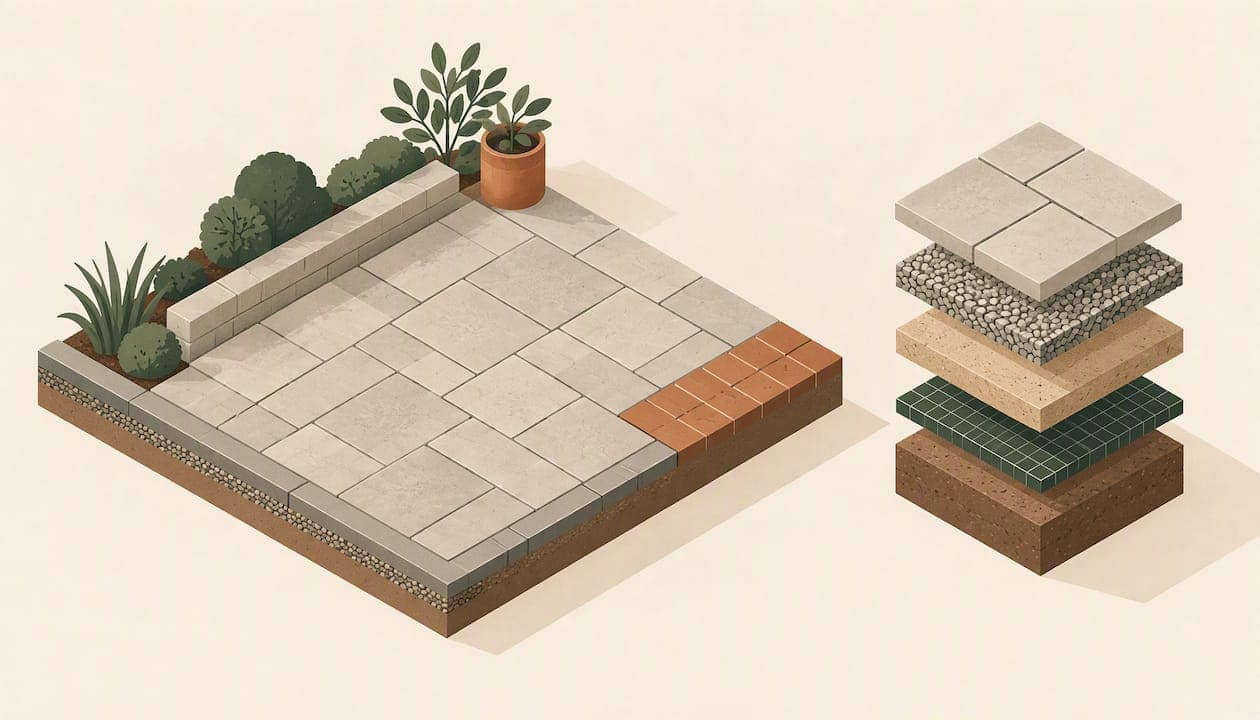
For paver patios, the same discipline applies: base, bedding, edge restraint and pavers are separate lines. We break those down in our 2026 paver patio cost guide and explain why very low bids deserve suspicion in Avoid Quotes Under $12 Per Sq Ft.
Why the same area can produce very different prices
Two contractors can measure the same 600 square feet and quote far apart. The Arizona DOT manual explains part of the reason: several pavement structures can satisfy a design requirement, and local drainage, frost, utilities, traffic and soil conditions can make a more expensive option the better one. It also warns that a pavement-structure estimate is not the total project cost, because drainage, utilities, grading, permits, access and landscaping may sit outside the paving line items.
In practice, these are the usual causes of a gap:
- Different base designs. One bid assumes 4 inches of stone, another 8.
- Different thickness or mix. The cheaper bid may be thinner.
- Scope. One includes tear-out and drainage fixes, the other does not.
- Site access. Hand work costs more than machine work.
- Local labor and material rates. These shift by region and by season. Our breakdown of 2026 landscaping labor rates shows how to price labor as its own line.
Site conditions also decide whether a finished surface needs more than paving. Once the surface is down, you may want parking stalls, fire lanes or markings. Pin Point Line Striping is a New Hampshire company that lists crack sealing, sealcoating and pavement marking among its services, a reminder to budget for the work that comes after the paving crew leaves.
Reading cost charts and regional examples without being fooled
Cost charts are useful only if you know what they measure. Label every figure you use with four things: country, date, scope and unit.
The 2021 Connecticut DOT pavement report shows why. Its approximate figures run from $16,500 for crack and joint sealing to $150,000 for an ultra-thin bonded overlay and $1,535,000 for new construction, and they are per two-lane mile. The report says costs vary significantly by project, location and timing. Those numbers describe roads, not a garden, and they are not transferable to another country.
The same discipline applies to the "per square foot" ranges you find online. A range that mixes asphalt, concrete and pavers, or that includes or excludes base work, tells you very little. If you build your own cost library from real quotes, as estimating teams do, your numbers become more reliable with every job. ArosBid describes the idea of a historical cost library for estimators, and a homeowner can borrow it on a small scale: save every quote, with date, scope and unit, in one place.
Asphalt, concrete or pavers: price versus life
The cheapest surface on day one is not always the cheapest over time. Cornell's guide to choosing a driveway surface reports asphalt at up to $6 per square foot and concrete at up to $12 per square foot, and describes concrete as lasting about 50 years or longer, against asphalt becoming old at about 20 years. Those are one university's figures for the U.S., not a price list for your town. Asphalt can usually take traffic sooner after installation, while concrete may need several days to a week to cure.
For homeowners, treat this as a decision framework:
| Factor | Asphalt | Concrete | Pavers |
|---|---|---|---|
| First cost | Generally lowest in the Cornell comparison | Higher in the Cornell comparison | Varies widely by material and pattern |
| Time to use | Sooner | Several days to a week | Depends on the base and bedding |
| Longevity | Shorter in the Cornell comparison | Longer in the Cornell comparison | Depends on base quality |
| Decorative range | Limited | Greater flexibility | Wide |
For larger or heavily loaded areas, transportation agencies compare options with life-cycle cost analysis. The Arizona DOT manual recommends it, and an Iowa State study on renewing lightly traveled roads found that the rehabilitation alternatives it examined cut rehabilitation and maintenance costs by 14% to 42% over 30- and 50-year analyses. Those results apply to the roads studied. They do not promise the same savings on a residential driveway, and they depend on the existing surface and subgrade being sound. For water-damaged or failed garden paving, assume nothing until a professional has looked at it.
Compaction: the line item you cannot see
A quote can specify the right tonnage and still deliver a short-lived surface if the material is poorly compacted. The Federal Highway Administration's density tech brief reports that a one-percentage-point increase in in-place density was estimated to improve fatigue performance by 8% to 44%, rutting resistance by 7% to 66%, and service life by about 10%. Its example estimated $88,000 in net present value savings on a $1 million project from that one point.

Those are highway figures. The lesson for a homeowner is narrower and still useful: paying for proper compaction may not make the quote look cheaper, but it can lower whole-life cost. Ask each contractor how they will compact the base and the asphalt, and what equipment they will use. Density targets depend on the mix's maximum specific gravity and lift thickness, as the Asphalt Institute explains.
Our perspective: an estimate should move when the design moves
We built Veete because we kept seeing the same failure. A client changes a patio from 12 by 16 feet to 14 by 18, and the spreadsheet still shows the old quantities. The price is out of sync with the plan, and nobody notices until the invoice.
The fix is not a better spreadsheet habit. It is to tie every price to an object in the plan. When a path gets wider, its area, its base, its edging and its material list change together, because they were never separate numbers. That is why paving is a good test of any estimating method: it is mostly area-driven, and area is exactly what changes during design.
Our advice to homeowners is to estimate in layers. First draw the plan to scale. Then price the surface, the base, the edges and the removal separately, using your own supplier or contractor rates. Finally, add contingency. If a bid cannot be mapped onto those layers, ask the contractor to break it down until it can.
— Rokas
Plan and price your paving in 3D
If you would rather not rebuild a spreadsheet every time the layout changes, you can draw the driveway, patio or path in Veete and see a live, itemized estimate that updates as you edit. You can enter your own supplier rates, export the plan and generate a shopping list. The Free plan needs no card and covers a single project. Paid plans are Home at €6 per month or €48 per year, and Pro at €19 per month or €168 per year. See the details on the Veete pricing page.
A five-minute checklist before you request bids
- Measure every section and note curves.
- Decide the finished thickness and ask the contractor to confirm the base depth.
- Mark what must be removed.
- Photograph drainage problems and note where water collects.
- Request itemized quotes with the same scope, so you can compare them line by line.
- Keep a 10% contingency. Our material list guide shows how to turn quantities into an order without guesswork.
If your paving is part of a larger yard project, solve drainage first. Our front yard landscaping plan explains why, and the guide to pricing landscaping services like a pro estimator shows how professionals structure their numbers.
FAQ
How do I calculate how much asphalt I need?
Multiply area in square feet by thickness in feet and by 145 lb/ft³, then divide by 2,000 to get tons. Add a waste allowance. A 600 ft² driveway at 3 inches compacted comes to about 10.9 tons before waste. Confirm the density and yield with your supplier before ordering.
Is a price per square foot enough to budget a paving job?
No. It is a rough check at best. The rate changes with region, year, thickness, base depth, removal and access. Build the estimate from separate lines, and use a per-square-foot figure only to see whether a quote is in a plausible range.
Is asphalt cheaper than concrete?
Usually on first cost. Cornell's guidance reports asphalt up to $6 per square foot and concrete up to $12, though it describes concrete as lasting longer. Which is cheaper over time depends on the climate, the base, the maintenance and how long you will own the property.
Why are my paving quotes so different?
The bids probably do not cover the same scope. Differences in base thickness, mix, compacted thickness, removal, drainage work and site access can each change the total. Ask each contractor for an itemized quote and compare the lines.
Sources
- Asphalt Paving Cost Calculator, PaveGauge
- How to Choose a Driveway Surface, Cornell
- Pavement Design Manual, Arizona DOT
- 2021 Connecticut Annual Pavement Report
- Alternate Design Methods to Renew Lightly Traveled Paved Roads, Iowa State
- Tech Brief: Density Demonstration Projects, FHWA
- Best Practices for Constructing and Specifying HMA Longitudinal Joints, Asphalt Institute
- How is Density Target Value established, Asphalt Institute